
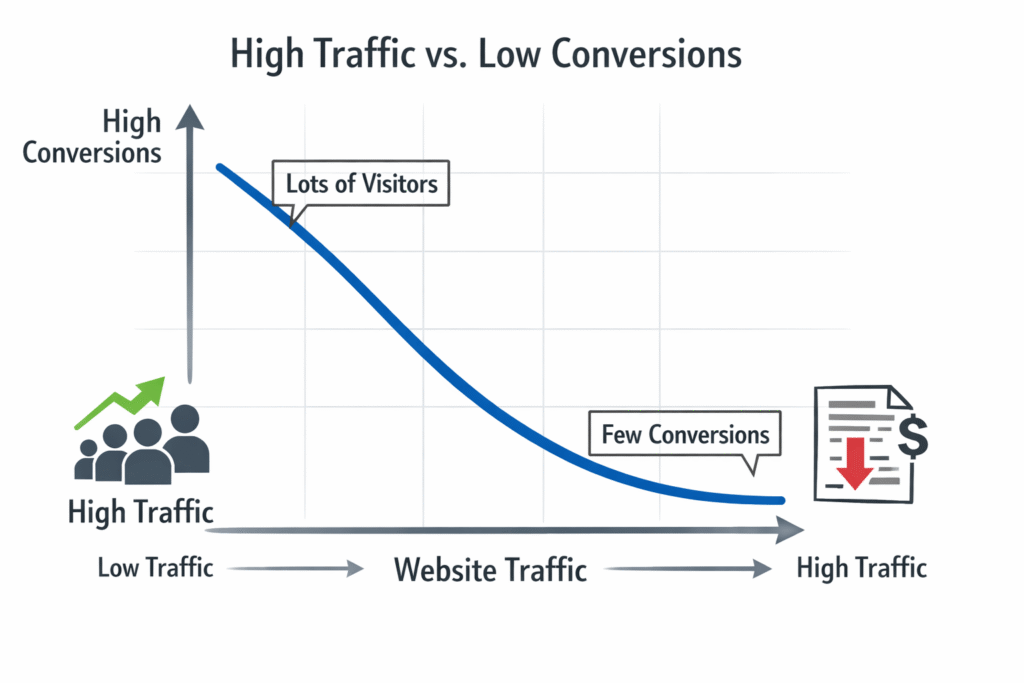
Running an online store in Lagos can be incredibly frustrating when you check your analytics and see hundreds of daily visitors, but your payment gateway dashboard shows zero successful transactions. You are pouring money into Meta and Google ads to drive traffic to your Nigerian e-commerce website, but no one is actually buying.
At NEULEAD, a Revenue + Systems agency based in Lekki Phase 1, we see this constantly. Many business owners blame the algorithm, the ad platform, or the economy. But in reality, their marketing is bringing people to a broken “money page.”
If your digital storefront is leaking money, you need to stop marketing and start selling. In this guide, we will identify the exact trust blocks, poor offer messaging, and weak lead capture forms that are destroying your conversion rates, and show you exactly how to fix them.
Why is my Nigerian e-commerce website getting traffic but no sales?
If your Nigerian e-commerce website is getting traffic but no sales, you have a conversion problem, not a traffic problem. This is usually caused by three critical errors: severe trust blocks that make buyers skeptical, poor offer messaging that confuses the visitor, and weak lead capture forms that create friction during checkout.
When you run ads to a poorly optimized website, you are actively burning your advertising budget. Meta’s algorithm is designed to find people likely to click, but it is your website’s job to make them pull out their credit cards. If your page takes too long to load or looks unprofessional, over 50% of mobile users will abandon it before it even opens.
To turn cold traffic into paying customers, you must build a tracking-first customer acquisition system that eliminates doubt and guides the user seamlessly to the checkout button.
What are trust blocks in e-commerce?
Trust blocks are missing credibility signals on your website that make a potential buyer feel unsafe spending their money. In the Nigerian market, where consumers are highly skeptical of online scams and the dreaded “what I ordered vs. what I got” phenomenon, failing to establish instant trust guarantees lost sales.
Strangers do not trust you. To convert cold traffic, your Nigerian e-commerce website needs strong trust blocks instantly visible above the fold. According to Google’s guidelines, your site must demonstrate E-E-A-T: Experience, Expertise, Authoritativeness, and Trustworthiness.
You can build this trust by displaying clear guarantees, prominently featuring a physical office address (like our Lekki Phase 1 location), providing a transparent return policy, and showcasing verifiable customer reviews. If a user cannot find a way to contact a real human being within five seconds of landing on your site, they will leave and buy from your competitor.
How does poor offer messaging ruin conversion rates?
Poor offer messaging ruins conversion rates by confusing the visitor about what the product is, how much it costs, and why they should care. If your headlines prioritize being “clever” over being “clear,” users will immediately bounce off the page.
Your headline is the most critical element of your product page. It must directly align with the ad or search query that brought the user to your website. If a customer clicks a Meta ad for “affordable leather shoes in Lagos” and lands on a page with a vague headline like “Step into Greatness,” the disconnect causes instant friction.
You must focus on clarity. A high-converting Nigerian e-commerce website uses a proven layout: a direct Headline, immediate Proof (reviews or video demonstrations), and an unavoidable Call to Action (CTA). Your product descriptions should focus on the benefits to the buyer, not just a dry list of features.
Why are weak lead capture forms costing you money?
Weak lead capture forms cost you money because they create unnecessary hurdles right when the customer is ready to buy. Asking for too much information, failing to offer a guest checkout option, or having a clunky mobile interface leads directly to massive cart abandonment.
When a user clicks “Add to Cart,” the checkout process should be frictionless. Do not force a first-time buyer to create an account, verify their email, and fill out a 15-field form just to buy a simple product. Only ask for the essential information needed to process the payment and deliver the item.
At NEULEAD, we build Automation & CRM Systems using tools like Make and n8n to streamline this process. We connect your lead capture forms directly to your database. Furthermore, by deploying ManyChat and WhatsApp DM automation, we ensure that if a user abandons their cart, an automated, human-like chat flow follows up instantly to recover the sale.
How to track e-commerce conversions effectively?
To track e-commerce conversions effectively, you must connect your website’s checkout process directly to your tracking pixels and analytics software, ensuring every successful sale is attributed to the exact ad or search term that generated it.
You cannot scale what you do not track. We verify tracking through Google Analytics 4 (GA4) and Meta pixel events so your business decisions are based on hard data. If you are not utilizing a tracking-first setup, you are just guessing.
When your Nigerian e-commerce website has clean tracking, you can deploy highly aggressive retargeting campaigns. Retargeting recovers warm visitors who clicked your ad, browsed your products, but left before completing the checkout. This is the exact strategy we use to drastically lower Cost Per Acquisition (CPA) for our clients.
Why mobile-first optimization is non-negotiable
Having great products and clear messaging means nothing if your website breaks on a smartphone. Google predominantly uses the mobile version of the content for indexing and ranking. This means Google evaluates your site based on how it performs on a mobile phone.
Because the vast majority of Nigerian consumers will discover your products on their mobile devices, mobile-first optimization is completely non-negotiable. Your buttons must be easy to tap, your images must load in milliseconds, and your checkout forms must perfectly fit a small screen.
To learn more about how Google assesses website performance and technical requirements, review the official Google SEO Starter Guide
Dominating AI Search with Product Schema
Traditional SEO is evolving, and modern Nigerian e-commerce websites must now optimize for Large Language Models (LLMs) like ChatGPT and Google’s AI Overviews. If someone asks ChatGPT, “Where can I buy authentic skincare products in Lagos?” you want your store to be the cited answer.
To achieve this, you must implement Product Schema and Review Schema markup. Schema markup is structured data—a few lines of code added to the backend of your site—that tells search engines and AI models exactly what you are selling, how much it costs, and what your customers rate it.
Additionally, write your product FAQs using Natural Language Processing (NLP) friendly formats. Use the exact questions your customers ask as your subheadings, and answer them directly. Do not use AI to generate your product descriptions; LLMs prefer to cite original, human-written content that provides unique value.
Stop Marketing. Start Selling.
If your digital storefront gets traffic but no sales, it is time to upgrade your infrastructure. You do not need to boost more random posts. You need a unified system that connects your traffic, conversion, follow-up, and reporting.
At NEULEAD, we build the customer and operations systems that Nigerian e-commerce websites need to thrive. We identify the biggest leak in your current setup—whether it is your offer clarity, page speed, tracking, or follow-up—and we implement the fastest fix.
We don’t run ads without fixing the conversion path, and we don’t build websites that just look pretty; we build “money pages” that actually sell.
Are you ready to stop optimizing for vanity metrics and start building pipeline and profit?
Request a Free Discovery Call Today and let NEULEAD transform your traffic into measurable revenue.