
The era of typing fragmented, robotic keywords into a search bar is officially over. Today, a massive segment of your global target audience is bypassing traditional search entirely. Instead, they are having fluent, conversational interactions with Large Language Models (LLMs) like ChatGPT, Perplexity, and Google’s AI Overviews.
If your marketing strategy still revolves around stuffing traditional keywords into blog posts to manipulate search engine rankings, you are completely misaligned with the future of digital acquisition. You might be getting empty impressions, but if your brand is not the definitive answer cited by AI chatbots, your sales pipeline will remain empty.
At NEULEAD, a Revenue + Systems agency headquartered in Lekki Phase 1, Lagos, we build global customer and operations systems for businesses worldwide. We believe that if an activity does not directly move the revenue needle, it is just vanity marketing noise. To survive in today’s highly competitive, international digital market, you must stop marketing and start selling.
To dominate AI search, you must find NLP-friendly keywords and answer the exact AI-driven questions your customers are asking. In this comprehensive 2026 guide, we will teach you the exact methods for using Google Autocomplete and ChatGPT to uncover these questions, and how to build a tracking-first customer acquisition system that converts AI traffic into predictable revenue.
What are NLP-Friendly Keywords?
To successfully find NLP-friendly keywords, you must first understand the technology behind modern search engines. NLP stands for Natural Language Processing, which is a field of artificial intelligence focused on the interaction between computers and human language.
NLP is the foundational technology that powers Large Language Models (LLMs) like ChatGPT. At their core, these models are essentially advanced prediction engines; they analyze millions of data points to predict what word comes next in a sentence. Creating NLP-friendly content means making it easier for computers to understand, interpret, and generate words for their users.
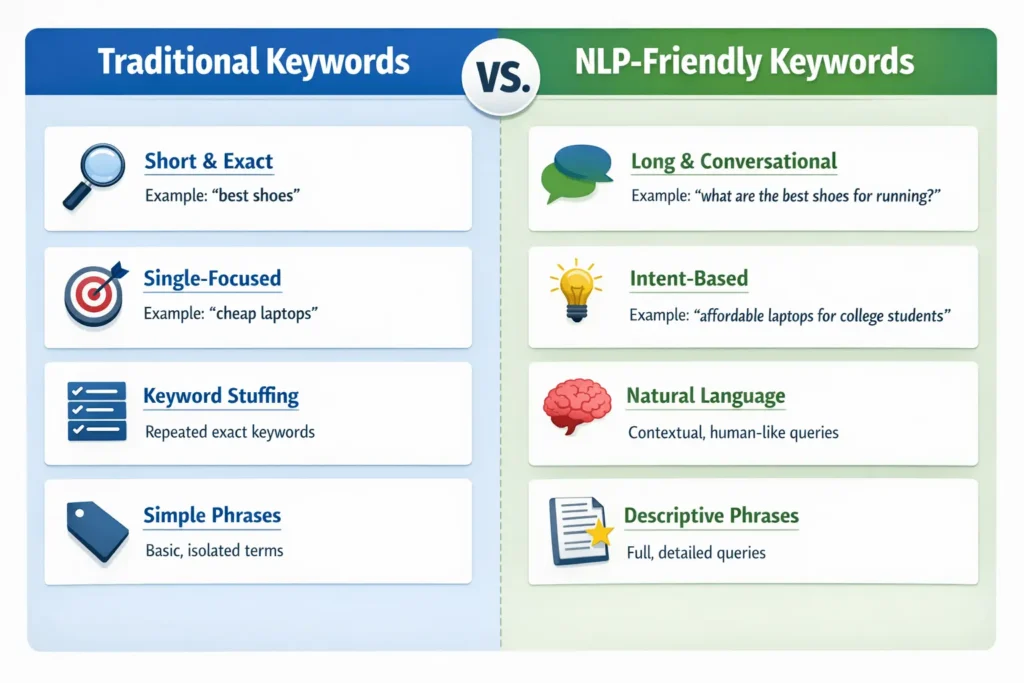
Traditional search queries used to look like this: “buy real estate Lagos.” Today, an NLP-friendly query looks like this: “What are the best real estate investment opportunities in Lagos for the global diaspora looking to buy property?”
If your website only targets the old, fragmented keywords, the AI will bypass your content. To capture this high-intent global traffic, you must pivot your strategy toward answering long-tail, conversational questions.
The Exact Method: How to Find AI-Driven Questions
The biggest challenge with LLM SEO is that traditional keyword research tools are often outdated. Because OpenAI does not yet have a comprehensive “Webmaster Tool” that displays exact search volume for ChatGPT prompts, marketers must use predictive autocomplete features to gather data.
Here is the exact, step-by-step method we use at NEULEAD to find NLP-friendly keywords for our global clients.
Step 1: Use Google Autocomplete and PAA
The first step in understanding what AI-driven questions users are asking is to look at Google’s predictive algorithms. Google’s language matching systems are incredibly sophisticated and understand the conversational nuances of modern searchers.
Open an incognito browser window and go to Google. Start typing your core service keyword, such as “How much does it cost to hire a…” and stop. Let Google’s autocomplete finish the sentence. These autocomplete suggestions represent real, high-volume questions that people are actively typing.
Additionally, perform a search and scroll down to the “People Also Ask” (PAA) section. These are the exact NLP-friendly questions your target audience is researching. Gather these questions; they will form the structural foundation of your new landing pages.
Step 2: Use ChatGPT Autocomplete (Incognito Method)
While Google is powerful, you must also see what users are asking directly inside LLM interfaces. To do this, you must leverage ChatGPT’s own predictive text features.
Go to chatgpt.com (or chat.com) in a fresh incognito window. Do not log into your account, as your past history can influence the algorithm. Begin typing about a topic you are creating a web page for. Use the autocomplete feature within the chat bar to see what specific, conversational prompts real people are searching for globally.
When you use this method to find NLP-friendly keywords, you bypass the guesswork. You are extracting the exact AI-driven questions that the language model is currently processing at a high volume. Document every relevant autocomplete suggestion.
Step 3: Map Questions to H2 and H3 Subheadings
Once you have gathered your list of AI-driven questions, you must structure your web page to feed this information directly to search engine bots. A massive wall of text is difficult for both humans and AI to read.
Take the exact questions you discovered via autocomplete and use them as your H2 and H3 subheadings on your web pages. By making the question a prominent heading, you are explicitly telling the AI crawler, “This section of the page directly answers this specific user prompt.” This structural clarity is a foundational SEO best practice that significantly improves your chances of being cited as an authoritative source.
Step 4: Answer in an NLP-Friendly Format
Having the right subheading is useless if the answer below it is vague or poorly structured. When someone searches for something like “what is AI” in ChatGPT, the AI responds in a highly structured, NLP-friendly format. This is exactly how you need to respond to the questions on your web pages.
Immediately below your H2 or H3 question, provide a direct, concise, and definitive answer in the very first paragraph. Do not use filler words. Write the answer as clearly as possible so the LLM can easily extract it and serve it to the user. After providing the direct answer, you can use the subsequent paragraphs to elaborate, provide examples, and add deeper context.
The Ultimate Trap: Never Use AI to Generate Content
It may sound incredibly ironic, but the absolute worst way to rank in AI search engines is to use AI to write your answers.
Many businesses use extensive automation to produce thousands of AI-generated blog posts, hoping to manipulate search rankings. If the primary “why” behind your content is simply to attract search engine visits rather than to help people, that is a direct violation of Google’s spam policies.
Furthermore, you must understand how these models learn. Large Language Models are constantly trained on new information and data. If you publish generic, AI-generated content, you are simply feeding the model information it already knows. If an LLM starts training itself on its own recycled data, it eventually leads to a degraded, terrible user experience.
If you want to win at LLM SEO and capture global traffic, you need to publish stuff the internet has not seen yet. This is the exact data that LLMs crave. You must write people-first content that shares proprietary data, real-world case studies, and unique insights that no AI could possibly invent.
Satisfying Google’s E-E-A-T Guidelines
To prove to search engines and AI models that your content is valuable, you must demonstrate strong E-E-A-T: Experience, Expertise, Authoritativeness, and Trustworthiness. Of these aspects, trust is the most important.
To build trust after you find NLP-friendly keywords, you must evaluate your content using Google’s “Who, How, and Why” framework:
- Who: Make it explicitly clear who created the content. Include author bylines and background information about the experts involved.
- How: Explain how a piece of content was produced. Share real-world case studies, proprietary data, and evidence of the work involved, such as original photographs.
- Why: The “why” should be that you are creating content primarily to help people, content that is useful to visitors if they come to your site directly.
When you write naturally and clearly demonstrate firsthand expertise, global users are far more likely to convert, and AI models are far more likely to cite your original insights as the definitive source.
Schema Markup: Feeding the AI Answer Engine
Finding the right questions and writing the right answers is only the front-end strategy. To truly dominate schema markup ChatGPT AI search, you must translate your content into a language that machines perfectly understand: structured data.
Schema markup is structured data that is essentially a few lines of JSON-LD code added to the backend of your web page. This code tells search engines exactly what your web page is about.
Because LLMs rely entirely on words and structured context, they love schema. When you wrap your newly discovered AI-driven questions in FAQ Schema, you feed the AI a direct “Question and Answer” roadmap. Almost all sources cited in a ChatGPT search have schema markup properly installed on their pages. At NEULEAD, we ensure all our clients’ landing pages feature complete FAQ, Article, and Local Business schema to guarantee maximum global visibility.
The Crucial Role of Bing Webmaster Tools
One of the most overlooked secrets in LLM SEO involves Microsoft Bing. While most marketers are exclusively obsessed with Google Search Console, ignoring Bing is a fatal error in the AI era.
Microsoft heavily backs OpenAI, and Bing’s search index directly powers much of the AI-driven search capabilities within ChatGPT. A significant amount of high Bing rankings translate directly over to ChatGPT’s search feature.
Once you find NLP-friendly keywords and build your optimized pages, you must set up an account on Bing Webmaster Tools. Verify your website, submit your XML sitemaps, and ensure Bing’s crawlers can access your JSON-LD data without restriction. A well-structured web page indexed on Bing frequently results in top citations on AI chat interfaces globally.
The NEULEAD Customer Engine™: Converting AI Traffic
Achieving top citations in AI chatbots is only the first step. If you successfully drive high-intent, global AI traffic to a website that loads slowly, has a confusing offer, or features a broken lead capture form, you are actively burning your budget and losing customers.
Google’s core ranking systems look to reward content that provides a good page experience. Even the best content can be disappointing to people if they arrive at a page that is cluttered or difficult to navigate.
At NEULEAD, we do not just “do marketing.” We build the full customer and operations system. We fix the entire chain: Traffic → Conversion → Follow-up → Operations. Here is exactly how our proprietary Customer Engine™ framework operates.
1. Capture (Conversion Websites)
We build high-converting WordPress websites and landing pages focused entirely on speed, clarity, and action. Your website must be a “money page.” We implement all necessary JSON-LD schema markup, ensure mobile-first optimization, and create a tracking-ready baseline (GA4 + pixel readiness) so that when global AI traffic arrives, it converts.
2. Attract (Paid Ads & LLM SEO)
Once the capture mechanism is flawless, we turn on the traffic. We manage Paid Ads across Meta, Google, X, and TikTok, alongside rigorous SEO Services. We use our methods to find NLP-friendly keywords, ensure your brand ranks for buyer-intent searches, and dominates AI citations across borders.
3. Convert (Tracking-First Retargeting)
We do not rely on vanity metrics or guesswork. We verify tracking so your business decisions are based on hard data. By deploying aggressive retargeting strategies, we recover warm visitors who clicked your AI-cited links but did not instantly convert, drastically dropping your Cost Per Lead (CPL).
4. Multiply (Automation & CRM)
Generating leads globally means nothing if your sales team drops the ball on the follow-up across different time zones. We build Automation & CRM Systems using Make/n8n and Google Sheets pipelines to route leads instantly. Furthermore, we deploy Chatbots & DM Automation (ManyChat + WhatsApp) to create human-like chat experiences that capture leads and escalate urgent cases 24/7.
Real Results: Driving Revenue With Systems
We do not optimize vibes; we optimize revenue. By abandoning vanity marketing and implementing tracking-first systems alongside advanced LLM SEO, we achieve measurable growth for our clients.
Dropping CPL from ₦6,800 to ₦1,200
A client was suffering from a broken conversion path. They were driving global traffic, but it wasn’t converting; people clicked and left, resulting in a devastating Cost Per Lead (CPL) of ₦6,800. We stepped in, rebuilt their landing page for conversion, verified their GA4 events, and added aggressive retargeting to recover warm visitors. Following these structural and tracking fixes, their CPL dropped to a highly profitable ₦1,200.
Admiralty Events: 87% Increase in Qualified Leads
Nnenna at Admiralty Events had a beautiful website, but they were struggling with low-quality inquiries and vanity metrics. By tightening their ad targeting and aggressively improving their landing page offer, we integrated our tracking-first systems. The result was an 87% increase in qualified leads in just 6 weeks. We improved their landing page conversion rate to 4.6% by creating a clearer offer, adding stronger trust blocks, ensuring a faster page speed, and simplifying the lead form.
Stopping Global Lead Loss with DM Automation
For an international client overwhelmed by DMs and missed after-hours leads, we built a comprehensive automated follow-up system. We deployed ManyChat DM flows with automatic qualification, WhatsApp handoff, and Telegram escalation. This system not only saved their team 6 hours per week but also reduced missed hot leads by 52% and dropped response times to under 2 minutes.
Optimizing for Multimodal AI Search
The only thing predictable in Search is that it always evolves because people’s needs are always evolving. Today, through the power of AI, people can perform multimodal searches where they snap a photo or upload an image, ask a question about it, and get a rich, comprehensive response with links to dive deeper.
To future-proof your digital strategy, you must go beyond standard text. When you find NLP-friendly keywords and write your answers, you must support your textual content with high-quality images and videos on your pages.
Always place these media assets near highly relevant text and use highly descriptive Alt Text. This ensures that when a global user searches visually, both human visitors and AI algorithms can perfectly understand the context of your offer, satisfying both multimodal queries and standard text-based LLM prompts.
Stop Marketing. Start Selling.
If you are tired of paying for impressions and likes while your competitors steal your market share through AI dominance, it is time to upgrade your infrastructure. You do not need more random, AI-generated blog posts. You need a unified system that connects traffic, conversion, follow-up, and reporting.
At NEULEAD, we build the customer and operations systems that modern businesses need to thrive locally and globally. We do not use templates, generic strategies, or fluff. We find the leak, build and launch the priority fix, and then optimize and scale what is working. If you sell something real, we can build the system.
Are you ready to stop wasting your budget on vanity metrics? We don’t run ads without fixing the conversion path, and we don’t do SEO without creating “money pages” that actually sell.
Request a Free Discovery Call Today and let NEULEAD transform your digital presence into a predictable, scalable revenue machine powered by elite AI search strategies. Let’s grow your pipeline together.