
The digital marketing landscape is currently experiencing a massive flood of low-quality information. With the rapid rise of artificial intelligence, millions of businesses are using extensive automation to produce thousands of AI-generated blog posts, hoping to blindly manipulate search engine rankings.
If your marketing strategy relies on this automated, search engine-first approach, you are walking into a trap. At NEULEAD, a Revenue + Systems agency headquartered in Lekki Phase 1, Lagos, we build global customer and operations systems for businesses worldwide. We know that generating empty impressions and vanity metrics will never grow your bank account. If an activity does not directly move the revenue needle, it is just noise.
To survive the evolution of organic search and Large Language Models (LLMs), you must stop marketing and start selling. This requires a profound shift in how you write. You must focus entirely on creating people-first content.
In this comprehensive 2026 guide, we will explain Google’s E-E-A-T guidelines, detail the “Who, How, and Why” framework, and reveal exactly why avoiding AI-generated content is vital for building a predictable, tracking-first customer acquisition system.
What is People-First Content?
Google’s automated ranking systems are explicitly designed to prioritize helpful, reliable information that is created to benefit people. People-first content means content that is created primarily for human readers, and not simply to manipulate search engine rankings.
To evaluate if you are on the right track, you must ask yourself a simple question: Do you have an existing or intended audience for your business that would find your content useful if they came directly to your site?
If you are a global real estate developer, does your article about property investments actually help an international buyer make a financial decision? After reading your content, a user should leave feeling that they have learned enough about the topic to help achieve their goal. If they leave feeling like they’ve had a satisfying experience, you have successfully created people-first content.
The Trap of Search Engine-First Content
In stark contrast, search engine-first content is made primarily to gain search rankings. This approach relies heavily on vanity metrics and outdated “growth hacks.”
Answering “yes” to any of the following questions is a massive warning sign that your current strategy is broken:
- Are you primarily making content to attract visits from search engines rather than to help a human buyer?
- Are you using extensive automation or AI to produce content on many different topics?
- Are you summarizing what others have to say without adding much original value?
- Are you writing to a specific word count simply because you heard Google prefers it?
If your content leaves readers feeling like they need to search again to get better information from other sources, Google’s algorithms will detect this poor user experience (often called pogo-sticking) and penalize your rankings. To win, you must transition to a people-first model.
Understanding Google’s E-E-A-T Guidelines
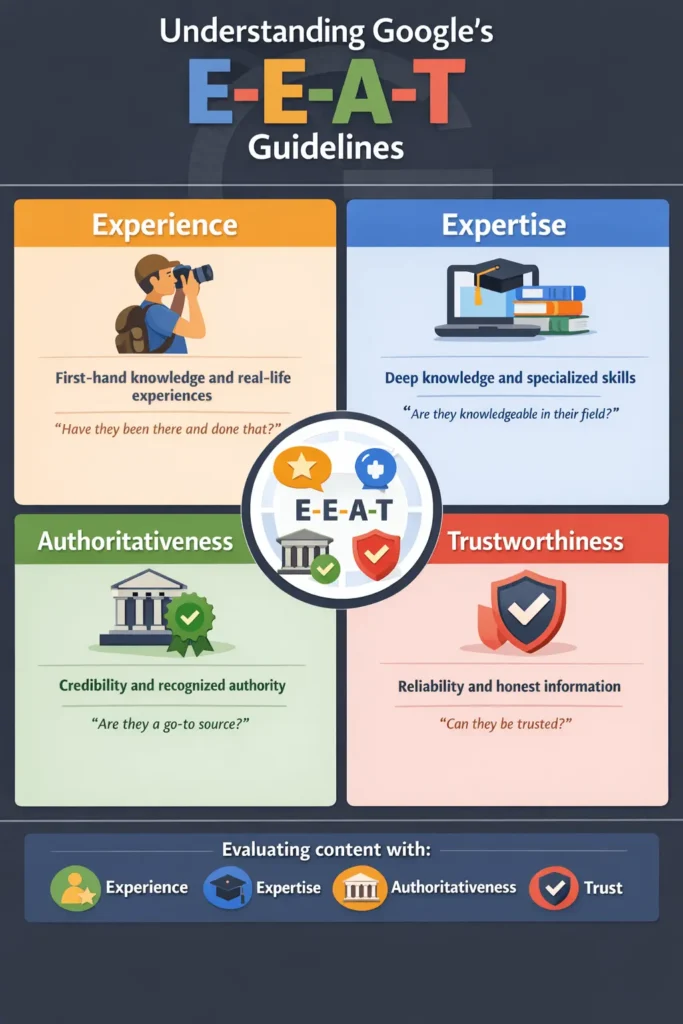
To determine which pages are truly helpful, Google’s automated systems use a mix of factors to evaluate if content demonstrates aspects of Experience, Expertise, Authoritativeness, and Trustworthiness. Collectively, this is known as Google’s E-E-A-T guidelines.
While E-E-A-T itself is not a direct, single ranking factor like a keyword or a backlink, Google’s systems give immense weight to content that aligns with strong E-E-A-T. This is especially true for “Your Money or Your Life” (YMYL) topics—topics that significantly impact the health, financial stability, or safety of people. If you operate a medical clinic or sell high-ticket real estate globally, E-E-A-T is your most critical asset.
Here is exactly how Google defines the four pillars of E-E-A-T.
1. Experience
Does your content demonstrate first-hand experience? For example, if you are writing a review of a software tool for B2B clients, did you actually use the tool? First-hand experience proves to the reader that your insights are grounded in reality, not just theoretical research copied from another website.
2. Expertise
Is the content written or reviewed by an expert who demonstrably knows the topic well? Expertise relates to the specific knowledge or qualifications of the author. A qualified dentist writing an article about a root canal demonstrates high expertise; a generic freelance writer covering the same topic demonstrates low expertise.
3. Authoritativeness
If someone researched your site, would they come away with the impression that it is well-trusted or widely recognized as an authority on its topic? Authoritativeness is built over time through industry recognition, high-quality backlinks, and consistent brand mentions across the global web.
4. Trustworthiness (The Most Important Pillar)
Of all these aspects, trust is the most important. Experience, expertise, and authoritativeness all contribute to trust. If your page lacks transparent contact information, verifiable customer reviews, or contains easily verified factual errors, your trust score plummets. Without trust, cold traffic will never convert into paying customers.
Ask “Who, How, and Why” About Your Content
To stay on course with what Google’s core ranking systems seek to reward, you should evaluate your people-first content using the “Who, How, and Why” framework.
Who (Created the Content)
It must be self-evident to your visitors who authored your content. Do your pages carry a clear byline? Do those bylines lead to further information about the author, giving background about their expertise? We strongly encourage adding accurate authorship information. People buy from people. Showing the actual humans behind your brand builds instant credibility with both human readers and search algorithms.
How (The Content Was Created)
It is incredibly helpful to readers to know exactly how a piece of content was produced. For example, if you are writing a case study, it builds trust when readers understand how the tests were conducted, accompanied by undeniable evidence of the work involved, such as original photographs or data charts. Transparency in your methodology is a massive ranking signal.
Why (Was the Content Created)
“Why” is perhaps the most important question to answer. The “why” must be that you are creating content primarily to help people. If the “why” is that you are primarily making content to attract search engine visits, that is completely misaligned with what search algorithms reward.
Why Avoiding AI-Generated Content is Vital
This brings us to the most critical warning for modern businesses: you must avoid relying on AI-generated content.
If you use automation, including AI generation, to produce content for the primary purpose of manipulating search rankings, that is a direct violation of Google’s spam policies. But beyond Google’s manual penalties, there is a much deeper, structural reason why avoiding AI-generated content is vital for LLM SEO (ranking in AI chatbots like ChatGPT and Perplexity).
LLMs Crave New Information
Large Language Models are trained on new information and data. If you use an LLM to write your blog posts, you are simply feeding the model information it already knows. You are providing zero original value.
The ultimate goal of AI search engines is to provide the best user experience possible. If an LLM starts training itself on its own recycled, AI-generated data, it eventually leads to a degraded, terrible user experience (a phenomenon data scientists call “model collapse”).
To win at LLM SEO, you need to publish stuff the internet has not seen yet. This original data is exactly what LLMs crave. By sharing proprietary data, unique global case studies, and genuine human insights, you provide the unique, people-first content that AI algorithms actively seek out and cite as authoritative sources.
LLM SEO: Structuring Data for AI Search
Writing excellent, human-driven content is only the first step. To ensure your people-first content performs well in AI search experiences, you must translate your human insights into a language that machines perfectly understand: structured data.
LLM SEO is the practice of optimizing your web content so that large language models can effectively understand it and present it to their users. LLMs rely entirely on Natural Language Processing (NLP). To capture this traffic, you must answer conversational, AI-driven questions directly on your web pages.
Furthermore, you must implement Schema Markup. Schema is a few lines of JSON-LD code added to the backend of your web page. This code explicitly tells the AI exactly what your page is about. Almost all sources cited in a ChatGPT search have schema markup properly installed on their pages. At NEULEAD, we ensure your high-converting landing pages feature complete FAQ, Article, and Local Business schema to guarantee maximum global visibility.
Providing a Great Page Experience
Google’s core ranking systems look to reward content that provides a good page experience. Even the absolute best content can be disappointing to people if they arrive at a page that is cluttered, difficult to navigate, or slow to load.
Because the vast majority of your global traffic will discover you on their mobile phones, mobile-first optimization is non-negotiable. Ensure that your page displays perfectly across devices, prioritize your site’s speed and latency, and verify that visitors can easily distinguish your main content from advertisements or pop-ups.
At NEULEAD, we do not do SEO without creating “money pages” that sell. We build high-converting WordPress websites focused entirely on speed, clarity, and action, ensuring that when your organic traffic arrives, it converts into a measurable inquiry.
Optimizing for Multimodal and Visual Search
The only thing predictable in Search is that it always evolves because people’s needs are always evolving. Today, through the power of AI, people can perform multimodal searches where they snap a photo or upload an image, ask a question about it, and get a rich, comprehensive response with links to dive deeper.
To achieve multimodal success, you must go beyond standard text. Support your people-first content with high-quality, sharp images and videos on your pages. Always place these media assets near highly relevant text and use highly descriptive Alt Text. This ensures that when a global user searches visually, both human visitors and AI algorithms can perfectly understand the context of your offer.
The NEULEAD Customer Engine™: Converting Traffic
Achieving top rankings and AI citations is meaningless if your sales pipeline remains empty. Most businesses leak sales in the gaps: traffic → weak page → slow follow-up → lost sale. We fix the full chain.
Here is the exact four-step Customer Engine™ framework we use to build high-performing systems for our clients globally.
1. Capture (Conversion Websites)
We build high-converting WordPress websites and landing pages focused entirely on speed, clarity, and action. Your website must be a tracking-ready baseline (GA4 + pixel readiness) so that when high-intent traffic arrives, it converts.
2. Attract (Paid Ads & SEO)
Once the capture mechanism is flawless, we turn on the traffic. We manage Paid Ads across Meta, Google, X, and TikTok, alongside rigorous Local and LLM SEO Services. We ensure your brand ranks for buyer-intent searches through highly optimized, people-first content.
3. Convert (Tracking-First Retargeting)
We do not rely on vanity metrics. We verify tracking so your business decisions are based on hard data. By deploying aggressive retargeting strategies, we recover warm visitors who read your content but did not instantly convert, drastically dropping your Cost Per Lead (CPL).
4. Multiply (Automation & CRM)
Generating organic leads means nothing if your team drops the ball on the follow-up. We build Automation & CRM Systems using Make/n8n to route leads instantly. Furthermore, we deploy Chatbots & DM Automation (ManyChat + WhatsApp) to create human-like chat experiences that capture leads 24/7.
Real Results: E-E-A-T in Action
We do not just talk about expertise; we prove it. Sharing undeniable evidence of how results were achieved is the ultimate way to satisfy Google’s E-E-A-T guidelines. Here are actual, measurable results we’ve achieved for our clients by abandoning vanity metrics and implementing the NEULEAD framework.
Admiralty Events: 87% Increase in Qualified Leads
Nnenna at Admiralty Events had a beautiful website, but they were struggling with low-quality inquiries. By tightening their targeting and aggressively improving their landing page offer with stronger trust blocks, we integrated our tracking-first systems.
The result was an 87% increase in qualified leads in just 6 weeks. We improved their landing page conversion rate to 4.6% by creating a clearer offer, ensuring a faster page speed, and simplifying the lead form.
Dropping CPL from ₦6,800 to ₦1,200
Another client was suffering from a broken conversion path. They were driving traffic, but it wasn’t converting; people clicked and left, resulting in a devastating Cost Per Lead (CPL) of ₦6,800.
We stepped in, rebuilt their landing page for conversion, verified their GA4 events, and added aggressive retargeting to recover warm visitors. Following these structural and tracking fixes, their CPL dropped to a highly profitable ₦1,200.
Stopping Lead Loss with CRM Automation
For an international client overwhelmed by Instagram DMs and missed after-hours leads, we built a comprehensive automated follow-up system. We deployed ManyChat DM flows with automatic qualification, WhatsApp handoff, and Telegram escalation.
This system saved their team 6 hours per week. Furthermore, it increased lead capture by 41%, reduced missed hot leads by 52%, and dropped global response times to under 2 minutes.
Stop Marketing. Start Selling.
If you are tired of paying for impressions and likes while your competitors steal your market share through AI dominance and elite SEO, it is time to upgrade your infrastructure. You do not need more random, AI-generated blog posts. You need a unified system that connects traffic, conversion, follow-up, and reporting.
At NEULEAD, we build the customer and operations systems that modern businesses need to thrive globally. We do not use templates, generic strategies, or fluff. We find the leak, build and launch the priority fix, and then optimize and scale what is working. If you sell something real, we can build the system.
Are you ready to stop wasting your budget on vanity metrics? We don’t run ads without fixing the conversion path, and we don’t do SEO without creating people-first content that actually sells.
Request a Free Discovery Call Today and let NEULEAD transform your digital presence into a predictable, scalable revenue machine. Let’s grow your pipeline together.