
The digital acquisition landscape is undergoing its most radical transformation in decades. The only thing predictable in Search is that it always evolves because people’s needs are always evolving. The classic “ten blue links” format changed to handle the needs of those seeking visual, video, news, and other types of content, and later evolved from desktop displays to mobile-friendly ones.
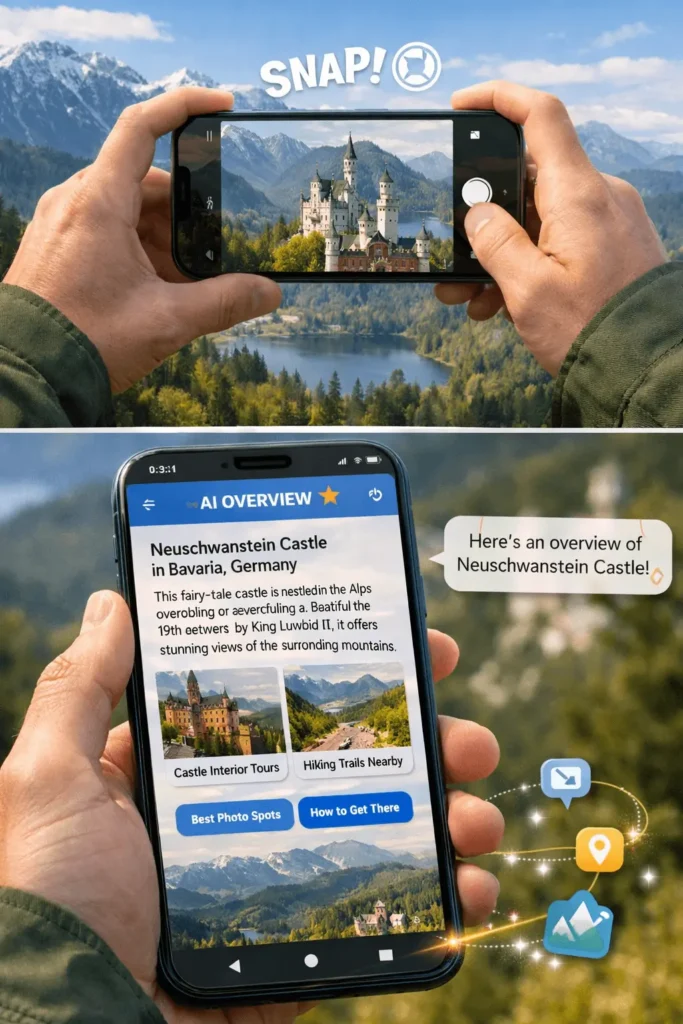
Today, we are entering the era of AI. Search has evolved to handle voice queries and “multimodal” queries, such as a user taking a picture of a flower and having Search identify it from the photos.
If your marketing strategy relies entirely on outdated, text-only keyword stuffing, you are trapped in vanity marketing. You might generate impressions, but if your brand cannot be found when a user snaps a photo or asks their voice assistant a question, your sales pipeline will remain empty.
At NEULEAD, a Revenue + Systems agency headquartered in Lekki Phase 1, Lagos, we build customer and operations systems for businesses targeting audiences everywhere. In this comprehensive 2026 guide, we will break down exactly how to optimize for Google’s multimodal search, focusing on how high-quality images and descriptive Alt Text act as your secret weapons for ranking in AI photo and voice searches.
What is Google’s Multimodal Search?
To capture modern, high-intent traffic, you must first understand how artificial intelligence processes information. Traditional search engines relied almost exclusively on text. You typed a query into a search bar, and the engine returned a list of web pages containing matching text.
Our AI experiences represent yet another evolution with Search, ensuring that search engines continue to best meet shifting user needs. Through the power of AI, people can now perform multimodal searches where they snap a photo or upload an image, ask a question about it, and get a rich, comprehensive response with links to dive deeper.
This means a user no longer has to know the exact name of your product or service. A potential buyer can take a photo of a broken pipe, a specific piece of real estate architecture, or a skin condition, and ask the AI, “Who can fix this near me?” If you have optimized your digital assets for Google’s multimodal search, your business will be the cited answer.
Why Text-Only SEO is Losing Market Share
Relying purely on text is a dangerous strategy in today’s visually driven internet. Many people search visually, and images can be how people find your website for the first time.
When users interact with AI Overviews and AI Mode, they are asking new and more complex questions, and they are generally more satisfied with their results. AI Overviews display links in a range of ways, showing a wider range of sources so it is easy for people to click out and explore content on the web.
If your website consists of massive walls of text with zero visual context, you are providing a poor page experience. Even the best content can be disappointing to people if they arrive at a page that is cluttered or difficult to navigate. To succeed in these advanced AI search experiences, you must support your textual content with high-quality images and videos on your pages.
7 Ways to Optimize for Voice & Image AI Search
If you want consistent enquiries and a system that actually closes, you must identify the biggest leak in your current search visibility. Here are the seven proven technical steps NEULEAD uses to build high-performing systems for clinics, real estate firms, e-commerce brands, and B2B services looking to capture multimodal traffic.
1. Add High-Quality Images Near Relevant Text
The foundation of ranking in Google’s multimodal search is the quality of your visual assets. When you use high-quality images, you give users enough context and detail to decide which image best matches what they were looking for.
For example, if people are looking for “daisies” and come across a rogue edelweiss in search results, a higher quality image would help them properly distinguish the type of flower. You must use images that are sharp and clear.
However, simply uploading a beautiful image is not enough. You must place them near text that is relevant to the image. The text that is near images can help Google better understand what the image is about and what it means in context to your page. If you run a dental clinic, placing a sharp photo of your facility right next to the paragraph describing your location gives the AI perfect context.
2. Master Descriptive Alt Text
If high-quality images are the foundation, descriptive Alt Text is the bridge that connects human visuals to machine understanding. Alt text is a short, but descriptive piece of text that explains the relationship between the image and your content.
Search engines and AI bots cannot “see” images the way humans do. They rely on the backend code. Alt text helps search engines understand what your image is about and the context of how your image relates to your page, making writing good alt text quite important.
You can add this to your HTML with the alt attribute of the img element, or your Content Management System (CMS) may have an easy way to specify a description for an image when you upload it to your site. Never leave this blank, and never stuff it with robotic keywords. Describe the image exactly as you would to a person who is visually impaired.
3. Optimize for Conversational Voice Search
Voice search is a massive component of Google’s multimodal search. When users speak to their mobile devices or smart speakers, they do not use fragmented keywords. They use natural language.
To rank in voice search, you must optimize for Large Language Models (LLMs) using Natural Language Processing (NLP). This means your website must answer the exact conversational questions your audience is asking.
Use Google’s autocomplete or ChatGPT to discover long-tail questions. Take those exact questions, use them as your H2 and H3 subheadings, and answer them directly and concisely immediately below. When a user asks their voice assistant a question, the AI will pull your NLP-friendly answer directly from your text, citing your brand as the authority.
4. Provide Visual Evidence to Satisfy E-E-A-T
Google’s automated systems are designed to use many different factors to rank great content, identifying a mix of factors that demonstrate Experience, Expertise, Authoritativeness, and Trustworthiness (E-E-A-T). Of these aspects, trust is the most important.
Visual optimization plays a massive role in building trust. It is incredibly helpful to readers to know exactly how a piece of content was produced, which is the “How” of your content strategy. For example, when showcasing results, it builds trust when readers understand how tests were conducted, accompanied by evidence of the work involved, such as photographs.
By providing original, high-quality images of your actual team, your actual office, or your actual products, you prove your firsthand experience. This authentic visual proof cannot be easily faked by AI-generated spam, making it a massive ranking signal for both human buyers and search algorithms.
5. Keep Business Profiles Up-To-Date
Many multimodal searches have high geographic and commercial intent. When someone snaps a photo of a broken product and asks “Where can I buy a replacement?”, the AI looks for local and relevant suppliers.
To ensure success with this type of search, you must ensure that your Google Merchant Center and Google Business Profile information is completely up-to-date.
Your business name, address, phone number, operating hours, and product inventory must be perfectly accurate. If an AI model cannot verify your operational details, it will not recommend your business to the user, no matter how beautiful your website images are.
6. Implement Schema Markup for Visual Context
While Alt Text describes individual images, Schema Markup (JSON-LD structured data) describes the entire context of your web page. Structured data is useful for sharing information about your content in a machine-readable way that search systems consider, making pages eligible for certain search features.
If you are using structured data, be sure to follow all guidelines, such as making sure that all the content in your markup is also visible on your web page.
When you combine high-quality images, descriptive Alt Text, and robust Image/Local Business Schema Markup, you give AI models a complete, undeniable roadmap to your content. This structural clarity guarantees that your business is prioritized when generating AI Overviews.
7. Avoid Search Engine-First Content
Finally, you must never optimize purely to trick the algorithm. We recommend that you focus on creating people-first content to be successful with Google Search, rather than search engine-first content made primarily to gain search engine rankings.
If you use extensive automation to produce content on many topics, or if you are mainly summarizing what others have to say without adding much value, that is a major warning sign.
When you write naturally, provide unique visual assets, and clearly demonstrate firsthand expertise, users are far more likely to convert. This people-first approach satisfies both human buyers and AI search algorithms, providing a predictable stream of high-intent traffic to your business.
The NEULEAD Customer Engine™
Achieving top rankings in Google’s multimodal search is only the first step. We have seen that when people click to a website from search results pages with AI Overviews, these clicks are higher quality, where users are more likely to spend more time on the site.
However, if you successfully drive this high-intent traffic to a website that loads slowly, has a confusing offer, or features a broken lead capture form, you are actively burning your budget. Most businesses leak sales in the gaps: traffic → weak page → slow follow-up → lost sale.
At NEULEAD, we fix the full chain. Here is exactly how our proprietary Customer Engine™ framework operates to ensure you capture and convert multimodal traffic.
1. Capture (Conversion Websites)
We build high-converting WordPress websites and landing pages focused entirely on speed, clarity, and action. Your website must be a “money page.” We implement all necessary visual optimizations, high-quality images, descriptive Alt Text, and mobile-first infrastructure so that when AI traffic arrives, it converts.
2. Attract (Paid Ads & LLM SEO)
Once the capture mechanism is flawless, we turn on the traffic. We manage Paid Ads across Meta, Google, X, and TikTok, alongside rigorous SEO Services (Local + LLM SEO). We ensure your brand ranks for buyer-intent searches and dominates AI photo and voice citations for audiences everywhere.
3. Convert (Tracking-First Retargeting)
We do not rely on vanity metrics or guesswork. We prioritize tracking so decisions are data-based. By deploying aggressive retargeting strategies, we recover warm visitors who clicked your AI-cited links but did not instantly convert, drastically dropping your Cost Per Lead (CPL).
4. Multiply (Automation & CRM)
Generating leads means nothing if your sales team drops the ball on the follow-up. We build Automation & CRM Systems using Make/n8n and pipelines to route leads instantly. Furthermore, we deploy Chatbots & DM Automation (ManyChat + WhatsApp) to create human-like chat experiences that capture leads and escalate urgent cases 24/7.
Real Results: Proven Revenue Systems
We do not optimize vibes; we optimize revenue. By abandoning vanity marketing and implementing tracking-first systems alongside advanced multimodal SEO, we achieve measurable growth for our clients. Sharing undeniable evidence of how results were achieved is the ultimate way to satisfy Google’s guidelines.
Admiralty Events: 87% Increase in Qualified Leads
Nnenna at Admiralty Events had a beautiful website, but they were struggling with low-quality inquiries. By tightening their targeting and aggressively improving their landing page offer, we integrated our tracking-first systems. The result was an 87% increase in qualified leads in just 6 weeks. We improved their landing page conversion rate to 4.6% by creating a clearer offer, stronger trust blocks, a faster page speed, and a simpler form.
Dropping CPL from ₦6,800 to ₦1,200
Another client was suffering from a broken conversion path. They were driving traffic, but it wasn’t converting; people clicked and left, resulting in a devastating Cost Per Lead (CPL) of ₦6,800. We stepped in, rebuilt their landing page for conversion, fixed their tracking, and added aggressive retargeting. Following these structural fixes, their CPL dropped to a highly profitable ₦1,200.
Stopping Lead Loss with CRM Automation
For a client overwhelmed by DMs and missed after-hours leads, we built a comprehensive automated follow-up system. We deployed ManyChat DM flows with automatic qualification, WhatsApp handoff, and Telegram escalation. This system saved their team 6 hours per week, increased lead capture by 41%, reduced missed hot leads by 52%, and dropped response times to under 2 minutes.
Stop Marketing. Start Selling.
If you are tired of paying for impressions while your competitors steal your market share through AI dominance, it is time to upgrade your infrastructure. You do not need more random, text-heavy blog posts. You need a unified system that connects traffic, conversion, follow-up, and reporting.
At NEULEAD, we build the customer and operations systems that modern businesses need to thrive. We do not use templates, generic strategies, or fluff. We find the leak, build and launch the priority fix, and then optimize and scale what is working. If you sell something real, we can build the system.
Are you ready to stop wasting your budget on vanity metrics? We don’t run ads without fixing the conversion path, and we don’t do SEO without creating “money pages” that actually sell.
Request a Free Discovery Call Today and let NEULEAD transform your digital presence into a predictable, scalable revenue machine powered by elite Google’s multimodal search strategies. Let’s grow your pipeline together.