
Running digital advertising campaigns without a rigid follow-up infrastructure is the absolute fastest way to burn through your marketing budget. You might log into your Meta Ads or Google Ads dashboard and see hundreds of clicks originating from highly targeted campaigns. However, when you check your CRM pipeline, your sales figures remain completely stagnant.
You are experiencing the devastating reality of lead decay. Most businesses leak sales in the exact same gaps: traffic arrives → the landing page is weak → the follow-up is slow → the sale is lost. At NEULEAD, a Revenue + Systems agency headquartered in Lekki Phase 1, Lagos, we build customer and operations systems for businesses that serve clients globally. We know that generating a lead is only the first ten percent of the battle.
If your marketing agency is celebrating “impressions” and low Cost Per Lead (CPL) metrics while your high-intent visitors are being ignored by your sales team, you are trapped in vanity marketing. If an activity does not directly move the revenue needle, it is just noise.
To survive in today’s highly competitive digital market, you must stop marketing and start selling. What businesses truly need are robust follow-up systems—specifically, automated WhatsApp and Telegram reminders—designed to instantly alert your sales team and ensure no opportunity ever slips through the cracks.
In this comprehensive 2026 guide, we will break down exactly how to build these automated alerts, how to stop lead decay, and how to build a predictable customer acquisition system that maximizes your return on investment.
What is Lead Decay? (The 5-Minute Rule)
Before you can fix your follow-up process, you must understand why speed is the ultimate currency in modern sales. Lead decay is the rapid decline in a prospect’s buying intent from the moment they submit their contact information.
When a user fills out a Meta Lead Form or submits a query on your website, they are at the absolute peak of their interest. They have a problem, they have found your potential solution, and they want answers immediately. In today’s hyper-connected, fast-paced digital world, consumer patience is practically non-existent.
Extensive sales data shows that if your team takes more than five minutes to contact a new lead, the odds of successfully qualifying that prospect drop exponentially. If you wait an hour, the lead has likely already googled a competitor, submitted another form, and started talking to their sales representative. If you wait 24 hours, the lead will likely forget they even filled out your form in the first place.
Why Manual Follow-Ups Always Fail
Many business owners rely on manual processes to distribute leads. A lead form is submitted, an email is sent to a general info@ inbox, and a manager eventually forwards it to an available sales representative.
This manual method is guaranteed to fail for several structural reasons:
- Email Inbox Blindness: Salespeople are inundated with emails. A lead notification email easily gets buried under newsletters, internal memos, and spam.
- Global Time Zones: If you are targeting the international diaspora for real estate investments, a lead might submit a form at 2:00 AM your local time. Without an automated system, that lead sits idle for six to eight hours.
- Lack of Accountability: When a lead is sent to a shared inbox, the “Bystander Effect” occurs. Everyone assumes someone else is handling it, resulting in no one handling it.
To completely eradicate these bottlenecks, you must deploy automated WhatsApp and Telegram reminders. By pushing notifications directly to the devices your sales team already uses constantly, you force immediate visibility and accountability.
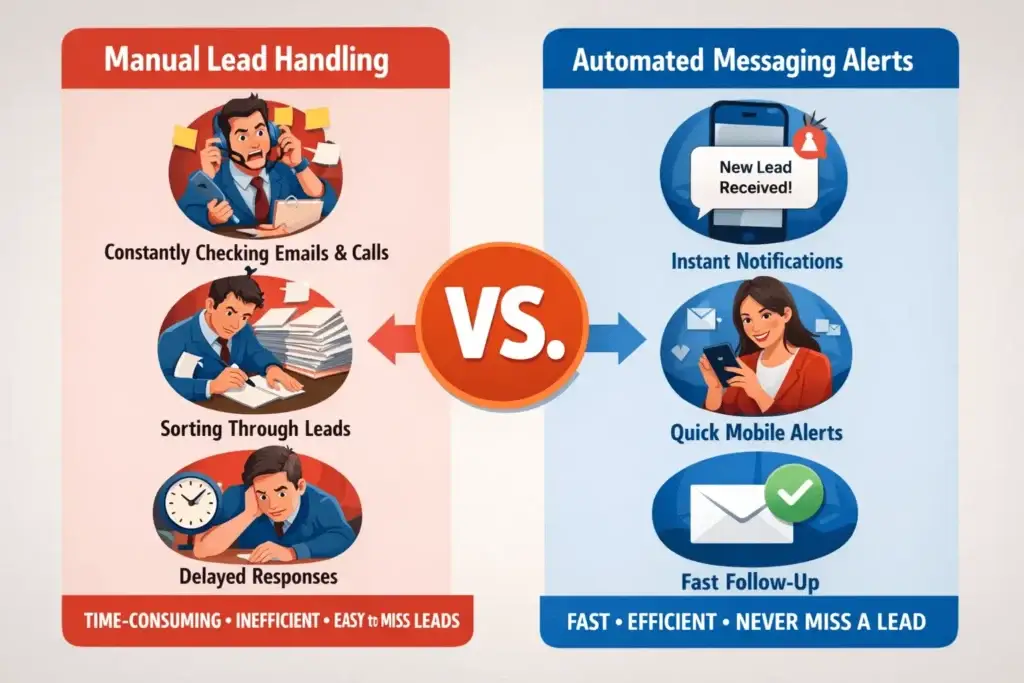
7 Steps to Set Up Automated Reminders and Stop Lead Loss
If you want consistent enquiries and a system that actually closes, you must identify the biggest leak in your follow-up process. Here is the exact seven-step framework NEULEAD uses to ensure your sales team never misses a follow-up.
1. Centralize Your Lead Capture Mechanisms
Automation without a unified starting point creates massive data fragmentation. Your first step is to ensure that all your lead sources—whether they are Facebook Lead Ads, WordPress website forms, TikTok Lead Generation, or direct emails—are configured to trigger a central webhook.
We do not run ads without fixing the conversion path. This means ensuring your website uses robust forms (like Gravity Forms or WPForms) that are fully tracking-ready and capable of sending instantaneous JSON data payloads the second a user clicks “Submit.”
2. Choose the Right Automation Engine (Make or n8n)
To route the data from your lead forms to your messaging apps, you need a visual automation tool. We rely heavily on platforms like Make (formerly Integromat) or n8n.
Make provides a highly intuitive, node-based interface that allows you to extract data from a source and push it anywhere. You will start your scenario with a “Trigger” module (e.g., a Custom Webhook or a Meta Lead Ads module) that actively listens 24/7 for new submissions.
3. Route Data into a Central CRM Pipeline
Before sending an alert, the automation must log the lead into a secure database. We build robust CRM pipelines using Google Sheets or Airtable.
Your automation scenario will take the incoming lead data (Name, Phone Number, Service Requested) and create a new row or record in your CRM. This creates a permanent, single source of truth for your business operations, ensuring that even if a message is missed, the data is safely stored for managerial review.
4. Deploy Telegram Escalation for Internal Teams
While WhatsApp is excellent for communicating with customers, Telegram is our preferred tool for internal team alerts. Telegram’s API is incredibly fast, highly reliable, and free to use for extensive bot integrations.
In your Make/n8n scenario, add a “Telegram – Send a Text Message” node. You will configure a custom Telegram Bot to push a message into a dedicated Sales Group Chat.
5. Format the Alert for Immediate Action
The formatting of your automated WhatsApp and Telegram reminders is critical. A vague message will be ignored. The alert must contain all the context the salesperson needs to act instantly without having to open the CRM.
Your automated Telegram message should look exactly like this: “🚨 NEW HIGH-INTENT LEAD 🚨 Name: John Doe Service: 4-Bedroom Duplex Inquiry Phone: +123456789 Time in: 14:02 PM Action: Click here to instantly open WhatsApp and message them!”
By including a pre-formatted wa.me/ click-to-chat link directly in the Telegram alert, your sales rep can tap the link on their phone and instantly start a conversation with the prospect in under ten seconds.
6. Build the 2-Hour Escalation Loop
The true power of an operations system lies in accountability. Sending one alert is good, but what if the sales rep is in a meeting?
We build delayed routing paths to ensure zero lead decay. You can configure your automation to wait for two hours after the initial lead capture. After two hours, the system will query your Airtable CRM. If the lead’s status is still marked as “New” (meaning no rep has changed it to “Contacted”), the system triggers a secondary, high-priority alert.
This secondary Telegram reminder is escalated directly to the Sales Director or Business Owner: “⚠️ ESCALATION: John Doe has been waiting 2 hours for a reply. Reassigning lead.” This completely stops lead loss and forces a culture of rapid response.
7. Connect ManyChat for Customer-Facing WhatsApp DM Automation
Internal alerts are crucial, but what about the customer’s experience? To create a truly unbreakable system, you must deploy automated WhatsApp and Telegram reminders alongside customer-facing chatbots.
At NEULEAD, we use ManyChat to build human-like chat experiences on Instagram DMs, Facebook Messenger, and WhatsApp. If a user messages your brand after business hours, ManyChat instantly answers FAQs, qualifies the buyer through conversational prompts, captures their phone number, and hands the data off to your Make/n8n pipeline.
This ensures that the customer receives an instant, satisfying response, while your team receives the structured data they need to close the deal the next morning.
The NEULEAD Customer Engine™ (The “Multiply” Cluster)
Building automated WhatsApp and Telegram reminders is just one specific component of a holistic business architecture. Most brands do not need more random “content” or generic marketing; they need a system that sells.
We categorize our services into a proprietary four-step framework known as the Customer Engine™. Operations automation falls into the critical final cluster.
1. Capture (Conversion Websites)
We build high-converting WordPress websites and landing pages focused entirely on speed, clarity, and action. We ensure mobile-first optimization so that global traffic seamlessly converts into trackable leads.
2. Attract (Paid Ads & SEO)
Once the capture mechanism is flawless, we turn on the traffic. We manage Paid Ads across Meta, Google, X, and TikTok, alongside rigorous Local and LLM SEO Services. We ensure your brand ranks for buyer-intent searches.
3. Convert (Tracking-First Retargeting)
We do not rely on guesswork. We verify tracking through Google Analytics 4 (GA4) and pixel events so your business decisions are based on hard, verifiable data. By deploying aggressive retargeting strategies, we recover warm visitors who clicked your links but did not instantly convert.
4. Multiply (Automation & CRM)
This is where we stop lead loss. We build CRM pipelines and team alerts using Make/n8n so opportunities never slip through. By automating lead routing, assignment, and escalation, we multiply the effectiveness of your sales team and drastically improve your close rate.
Real Results: E-E-A-T and Proven Revenue Systems
We do not optimize vibes; we optimize revenue. Google’s automated ranking systems are explicitly designed to reward content that demonstrates Experience, Expertise, Authoritativeness, and Trustworthiness (E-E-A-T). Of these aspects, trust is the most important.
To build trust with both human readers and search engines, we must answer the “How” by sharing undeniable evidence of the work involved and the real-world results achieved. Here is how our tracking-first frameworks perform in the real world:
Stopping Lead Loss with CRM & DM Automation
An international client of ours was overwhelmed by Instagram DMs and scattered website forms. Their sales team was missing after-hours leads due to massive time zone differences.
We built a comprehensive knowledge base and implemented ManyChat DM flows. We combined this with automated WhatsApp and Telegram reminders, adding automatic qualification, WhatsApp handoff, and Telegram escalation for their sales directors.
The result? Lead capture increased by 41%, global response times dropped to under 2 minutes, and missed hot leads were reduced by a staggering 52% in just 3 weeks. Furthermore, this system saved their operations team over 6 hours per week in manual data entry.
Admiralty Events: 87% Increase in Qualified Leads
Nnenna at Admiralty Events had a beautiful website, but they were struggling with low-quality inquiries and tracking issues. By tightening their targeting and aggressively improving their landing page offer, we integrated our tracking-first systems.
The result was an 87% increase in qualified leads in just 6 weeks. We improved their landing page conversion rate to 4.6% by creating a clearer offer, stronger trust blocks, ensuring a faster page speed, and simplifying the lead form.
Dropping CPL from ₦6,800 to ₦1,200
Another client was suffering from a broken conversion path. They were driving traffic, but it wasn’t converting; people clicked and left, resulting in a devastating Cost Per Lead (CPL) of ₦6,800.
We stepped in, rebuilt their landing page for conversion, verified their GA4 events, and added aggressive retargeting to recover warm visitors. Following these structural and tracking fixes, their CPL dropped to a highly profitable ₦1,200.
LLM SEO: Ranking in ChatGPT and AI Search
Fixing your operations and documenting your expertise online has a massive secondary benefit: it prepares your brand for the future of organic search.
Today, people are bypassing traditional search engines and directly asking Large Language Models (LLMs) like ChatGPT, Perplexity, and Google’s AI Overviews for direct, synthesized answers. LLM SEO is the practice of optimizing your web content so that large language models can effectively understand it, extract it, and present it to their global users.
If your marketing strategy relies purely on outdated keyword stuffing, you are losing massive market share. To ensure your content ranks in AI search experiences, you must implement highly technical strategies.
Answer NLP-Friendly Questions
Large Language Models are fundamentally built on Natural Language Processing (NLP). Creating NLP-friendly content means making it easier for computers to interpret and generate words for its users.
When an operations manager asks an AI, “How do I stop losing leads using WhatsApp?”, you want your website to be the cited answer. Use Google Autocomplete or ChatGPT to find the exact conversational questions your audience is asking. Use those questions as your subheadings (H2s and H3s) and provide direct, concise answers immediately below them.
Implement Schema Markup for AI Context
Schema Markup is structured data, usually a JSON-LD file, added to the head section of your web page’s code. This code tells search engines exactly what your web page is about.
LLMs absolutely love schema because they rely entirely on words and structured context. Almost all sources cited in a ChatGPT search have schema markup properly installed on their pages. Ensure your pages feature FAQ Schema, Article Schema, and Local Business Schema to guarantee maximum global AI visibility.
Never Use AI-Generated Content
It may sound ironic, but the absolute worst way to rank in AI search engines is to use AI to generate your content.
LLMs are trained on new information and data. If you use AI to write your blog posts, you are simply feeding the model information it already knows. This violates Google’s spam policies if done to manipulate search rankings, and it provides zero value to the AI ecosystem.
Google’s core ranking systems seek to reward people-first content that provides unique, original information, reporting, research, or analysis. If you want to win at LLM SEO, you need to publish stuff the internet has not seen yet. Genuine, human-written content backed by proprietary data (like our CPL reduction case studies) is exactly what AI algorithms actively seek to reward.
Setting Up Bing Webmaster Tools
One of the most overlooked secrets in LLM SEO involves Microsoft Bing. Bing’s search index heavily powers much of the AI-driven search capabilities within ChatGPT. A significant amount of high Bing rankings translate directly over to ChatGPT’s search feature.
If you want your fully optimized, schema-rich landing pages to be cited as authoritative sources, you must set up a free account on Bing Webmaster Tools. Verify your website, submit your XML sitemaps, and ensure Bing’s crawlers can access your JSON-LD data without restriction.
Satisfying Google’s “Who, How, and Why”
To stay on course with what Google’s core ranking systems seek to reward, you should consistently evaluate your content using the “Who, How, and Why” framework.
- Who: Make it explicitly clear who created the content. Include author bylines and background information about the experts involved. We clearly state that the NEULEAD Systems Team authors this highly technical content.
- How: Explain how a piece of content was produced. Share real-world case studies, proprietary data, and evidence of the work involved. By sharing the exact 7 steps we use to build our automated WhatsApp and Telegram reminders, we prove our first-hand experience.
- Why: The “why” should be that you are creating content primarily to help people, content that is useful to visitors if they come to your site directly.
When you write naturally, avoid search engine-first spam, and clearly demonstrate firsthand expertise, users are far more likely to convert into paying clients.
Stop Marketing. Start Selling.
If you are tired of paying for impressions, likes, and vanity metrics while your sales pipeline leaks high-quality leads, it is time to upgrade your infrastructure. You do not need another generic marketing campaign. You need a unified system that connects traffic, conversion, follow-up, and operations.
At NEULEAD, we build the customer and operations systems that modern businesses need to thrive globally. We do not use templates, generic strategies, or fluff. We find the leak, build and launch the priority fix, and then optimize and scale what is working. If you sell something real, we can build the system.
Are you ready to stop losing leads to slow, manual follow-ups? We don’t generate leads without building the follow-up systems that close.
Request a Free Discovery Call Today and let NEULEAD transform your manual processes into a predictable, scalable revenue machine powered by elite automated WhatsApp and Telegram reminders. Let’s multiply your pipeline together.