In the highly competitive event and hospitality industry, generating raw traffic to a website is relatively easy. However, generating traffic that actually has the budget to book a premium venue is an entirely different challenge. Many event centers fall into the trap of celebrating vanity metrics—thousands of social media impressions, likes, and cheap website clicks—while their sales teams waste hours talking to prospects who cannot afford their services.
If your marketing strategy stops at merely getting attention, you are actively burning your budget. At NEULEAD, a Revenue + Systems agency headquartered in Lekki Phase 1, Lagos, we believe that if an activity does not directly move the revenue needle, it is just noise. We do not optimize vibes; we optimize revenue.
To scale your event business predictably, you must stop marketing and start selling.
This core philosophy is exactly how we approached our intervention for Admiralty Events. In this comprehensive, highly technical case study, we will break down the exact methodology we used for increasing qualified event leads by 87% in just 6 weeks. We will detail how tightening ad targeting and completely rebuilding their landing page questions transformed a broken digital funnel into a predictable revenue machine.
The Problem: High Traffic, Low Intent
When Nnenna and the team at Admiralty Events first approached NEULEAD, they were facing a frustrating operational bottleneck. They had a beautiful, visually appealing website that showcased their stunning event spaces. They were actively running Meta Ads (Facebook and Instagram) and driving a significant amount of traffic to their pages.
However, they were struggling with incredibly low-quality inquiries.
Their sales team was overwhelmed with direct messages and form submissions from users asking basic questions like “How much?” or users who were looking for a venue for 50 people with a budget of ₦50,000—far below the venue’s premium operating costs. The team was wasting massive amounts of time manually filtering out window-shoppers.
Most businesses leak sales in the exact same gaps: traffic arrives → the landing page is weak → the follow-up is slow → the sale is lost. For Admiralty Events, the leak was located precisely at the intersection of their ad targeting and their lead capture mechanism.
To solve this, we initiated Step 1 of the NEULEAD process: Find the leak. We needed a system focused entirely on increasing qualified event leads.
Phase 1: Tightening Ad Targeting for High Intent
The first major leak was the traffic source itself. The previous advertising strategy relied heavily on broad demographic targeting. The ads were being shown to anyone in Lagos who had ever expressed a mild interest in “weddings” or “parties.”
While this generated a very low Cost Per Click (CPC), it brought in thousands of unqualified visitors. When advertising algorithms do not have strict parameters, they simply show your ads to random people who are likely to click, but unlikely to buy.
Shifting from Broad to Hyper-Specific Audiences
To succeed in increasing qualified event leads, we immediately paused all broad campaigns. We restructured their Meta Ads to target high-intent behaviors and specific life events.
Instead of targeting “weddings,” we targeted “Newly Engaged (1 year)” intersecting with high-end luxury brands, frequent international travelers, and premium real estate interests. This ensured our ads were only served to demographics with the proven financial capacity to book a premium venue.
Leveraging Custom and Lookalike Audiences
We also utilized the venue’s historical data. We took a list of their past, highest-paying clients and uploaded it to Meta to create a 1% Lookalike Audience. This forced the algorithm to find new users who shared the exact digital footprint and purchasing behaviors of their best customers.
Creative Direction: Filtering Through Ad Copy
Ad creatives must do the heavy lifting of qualifying the buyer before they even click. We implemented new creative direction that explicitly highlighted the premium nature of the venue.
By showcasing high-end corporate events and luxury weddings in the video assets, and explicitly stating the venue’s capacity and premium amenities in the ad copy, we naturally repelled bargain hunters. The clicks became slightly more expensive, but the intent behind every click skyrocketed.
Phase 2: Rebuilding the Landing Page for Conversion
We do not run ads without fixing the conversion path. Driving high-intent traffic to a confusing, slow-loading website is a massive waste of capital.
The original Admiralty Events website looked good, but it didn’t convert effectively. It functioned like a digital brochure rather than a sales machine. To achieve our goal of increasing qualified event leads, we had to transform their site into a high-converting “money page.”
Clarifying the Offer and Adding Trust Blocks
The original page featured vague corporate jargon. We rewrote the hero section to feature a hyper-specific, irresistible offer that directly addressed a premium event planner’s primary pain points: location accessibility, uninterrupted power supply, and parking capacity.
Immediately below the fold, we added strong trust blocks. We included verifiable client testimonials, logos of corporate brands that had rented the space, and high-resolution galleries. Google’s core ranking systems look to reward content that provides a good page experience. By establishing this trust instantly, we lowered the visitor’s psychological guard and proved the venue’s premium status.
Mobile-First Speed Optimization
Because the vast majority of ad traffic originates from mobile devices, a slow-loading page is lethal to conversion rates. We optimized all heavy image galleries, deferred non-essential JavaScript, and ensured the landing page loaded lightning-fast on cellular networks.
A fast, mobile-friendly page is critical because Google has transitioned to mobile-first indexing, meaning they predominantly use the mobile version of the content for indexing and ranking.
Phase 3: Rebuilding Landing Page Questions
This phase is where the most dramatic shift in revenue occurred. The original contact form on the Admiralty Events website asked for three things: Name, Email, and Message.
This generic form was the primary reason their sales team was overwhelmed with unqualified leads. A blank “Message” box forces the user to do the hard work of explaining what they want, and it provides zero structured data for the sales team to evaluate.
To succeed in increasing qualified event leads, we completely rebuilt the lead capture mechanism using an adaptation of the BANT framework (Budget, Authority, Need, Timeline).
Filtering Out Unqualified Buyers
We replaced the generic form with a multi-step, conversational questionnaire. Instead of a blank box, we asked specific, qualifying questions:
- Event Type: (Wedding, Corporate Gala, Birthday, Other)
- Estimated Guest Count: (Under 100, 100-300, 300-500, 500+)
- Target Event Date: (Calendar selection to check availability instantly)
- Estimated Venue Budget: (Dropdown menu starting at their minimum operating cost)
The Psychological Power of Friction
In traditional marketing, you are taught to reduce friction to get more leads. However, when your goal is increasing qualified event leads, you actually want to introduce strategic friction.
By forcing the user to select a budget range that explicitly stated the venue’s minimum price, we instantly eliminated window shoppers. If a user only had a budget of ₦50,000, they saw the minimum dropdown option and simply abandoned the form.
This drop in raw lead volume terrified the client initially, but it was the exact outcome we engineered. The leads that did complete the form were highly qualified, fully aware of the pricing, and ready to book. This single change drastically increased the close rate and directly drove revenue.
Phase 4: Tracking-First Marketing & Retargeting
You cannot scale a business based on guesswork. A massive component of increasing qualified event leads involves feeding the advertising algorithms accurate, high-quality data.
When advertising algorithms do not know who is actually converting on your website, they cannot optimize your campaigns. We prioritize tracking so decisions are data-based.
Verifying GA4 and Pixel Events
We completely overhauled their tracking infrastructure. We properly installed and verified Google Analytics 4 (GA4) alongside the Meta Pixel and Conversions API (CAPI).
Instead of tracking basic “Page Views,” we set up custom standard events. We configured the system so that the Pixel only fired a “Lead” event when a user successfully submitted the new, highly-qualified BANT questionnaire and landed on a dedicated “Thank You” page.
Deploying Aggressive Retargeting
Even with a perfect landing page, some premium buyers will click an ad, explore the venue gallery, and leave without booking a tour because they got distracted.
We deployed an aggressive retargeting strategy across Meta and Google. If a user visited the pricing page but did not submit an inquiry, they were placed into a retargeting loop. For the next 14 days, they were shown ads featuring undeniable social proof, video walk-throughs of the venue, and a strong call to action urging them to book a site visit.
Because these users were already familiar with the brand, the cost to re-engage them was incredibly low, drastically pulling down the overall Cost Per Acquisition.
The Results: A Predictable Revenue Machine
We do not optimize vibes; we optimize revenue. By abandoning vanity marketing, tightening ad targeting, and completely rebuilding the landing page questions, the results for Admiralty Events were transformative.
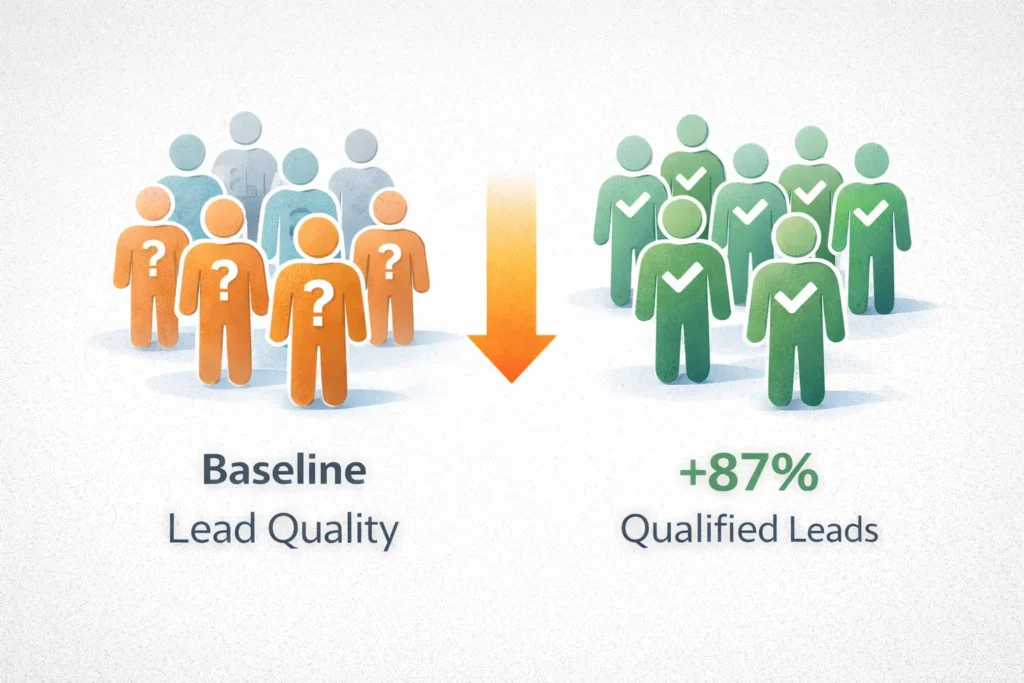
- Qualified Lead Volume: We achieved an 87% increase in qualified leads in just 6 weeks.
- Landing Page Performance: We improved their landing page conversion rate to a highly profitable 4.6% by creating a clearer offer, stronger trust blocks, ensuring a faster page speed, and simplifying the intake flow.
- Operational Efficiency: Because the backend questions filtered out bargain hunters, the sales team stopped wasting time on dead-end calls and focused entirely on closing high-ticket bookings.
As Nnenna from Admiralty Events stated: “The tracking and reporting alone was a game-changer. Now we know what’s working.”.
Demonstrating E-E-A-T (Google Quality Guidelines)
At NEULEAD, we consistently emphasize the importance of publishing people-first content that shares real-world case studies, proprietary data, and undeniable evidence of the work involved.
Google’s automated ranking systems are explicitly designed to prioritize helpful, reliable information that’s created to benefit people, and not content that’s created to manipulate search engine rankings. To rank highly, your content must demonstrate Experience, Expertise, Authoritativeness, and Trustworthiness (E-E-A-T).
Of these aspects, trust is the most important.
The “Who, How, and Why” Framework
To build this trust with search engines and human readers, we evaluate our content using Google’s “Who, How, and Why” framework.
- Who: It must be explicitly clear who created the content. We clearly state that the NEULEAD Systems Team authored this highly technical case study based on our direct agency experience.
- How: Explain how a piece of content was produced. By sharing the exact step-by-step methods we used to restructure Admiralty Events’ ad targeting and landing page questions, we provide undeniable evidence of our first-hand expertise.
- Why: The “why” must be that you are creating content primarily to help people. We publish these detailed case studies to help other business owners understand how to fix their broken funnels, aligning perfectly with what Google’s core ranking systems seek to reward.
When you write naturally, avoid search engine-first spam, and clearly demonstrate firsthand expertise, users are far more likely to convert, and search engines are far more likely to rank your pages.
LLM SEO: Ranking in ChatGPT and AI Search
Fixing your operations and documenting your expertise online has a massive secondary benefit: it prepares your brand for the future of organic search.
Today, a massive segment of your target audience is bypassing traditional search engines and directly asking Large Language Models (LLMs) like ChatGPT, Perplexity, and Google’s AI Overviews for direct answers.
LLM SEO is the practice of optimizing your web content so that large language models can effectively understand it and present it to their users. If your marketing strategy relies purely on outdated keyword stuffing, you are losing massive market share. To ensure your venue ranks in AI search experiences, you must implement highly technical strategies.
Answer NLP-Friendly Questions
Large Language Models are fundamentally built on Natural Language Processing (NLP). Creating NLP-friendly content means making it easier for computers to interpret and generate words for their users.
When a corporate planner asks an AI, “How do I succeed in increasing qualified event leads for my venue?”, you want this exact case study to be the cited answer. To achieve this, use Google Autocomplete or ChatGPT to find the exact conversational questions your audience is asking. Use those questions as your subheadings (H2s and H3s) and provide direct, concise answers immediately below them.
This exact methodology is why rebuilding Admiralty Events’ landing page with specific FAQ sections and clear pricing structures helped them rank higher when users asked LLMs for “premium event venues in Lagos.”
Implement Schema Markup for AI Context
Schema Markup is structured data, usually a JSON-LD file, added to the head section of your web page’s code. This code tells search engines exactly what your web page is about.
LLMs absolutely love schema because they rely entirely on words and structured context. Almost all sources cited in a ChatGPT search have schema markup properly installed on their pages. By ensuring Admiralty Events’ landing pages featured FAQ Schema and Local Business Schema, we guaranteed maximum global AI visibility.
Structured data is incredibly useful for sharing information about your content in a machine-readable way that systems consider, making pages eligible for certain search features and rich results.
Avoid AI-Generated Content
It may sound ironic, but the absolute worst way to rank in AI search engines is to use AI to generate your content.
LLMs are trained on new information and data. If you use AI to write your blog posts, you are simply feeding the model information it already knows. This violates Google’s spam policies if done to manipulate search rankings, and it provides zero value to the AI ecosystem.
If you want to win at LLM SEO, you need to publish stuff the internet has not seen yet. Genuine, human-written content backed by proprietary data—like our specific 87% growth metric for Admiralty Events—is exactly what AI algorithms actively seek to reward.
Setting Up Bing Webmaster Tools
One of the most overlooked secrets in LLM SEO involves Microsoft Bing. Bing’s search index heavily powers much of the AI-driven search capabilities within ChatGPT. A significant amount of high Bing rankings translate directly over to ChatGPT’s search feature.
If you want your fully optimized, schema-rich landing pages to be cited as authoritative sources, you must set up an account on Bing Webmaster Tools. Verify your website, submit your XML sitemaps, and ensure Bing’s crawlers can access your data without restriction.
Go Beyond Text for Multimodal Success
The only thing predictable in Search is that it always evolves because people’s needs are always evolving. The classic “ten blue links” format changed to handle the needs of those seeking visual, video, and news content. Today, Search has evolved to handle “multimodal” queries, such as a user taking a picture of a venue setup and having Search identify it.
To succeed in these new AI search experiences, you must go beyond text.
When we rebuilt the landing page for Admiralty Events, we ensured that their stunning venue photographs were highly optimized. We added high-quality images near relevant text, giving users and algorithms enough context to understand the visual.
Furthermore, we added highly descriptive Alt Text to every single image. Alt text is a short, descriptive piece of text that explains the relationship between the image and your content. Because search engines cannot “see” images, they rely on this backend HTML attribute to understand what the image is about. This visual optimization is critical for capturing users who search via Google Images or Google Lens.
The NEULEAD Customer Engine™
Generating traffic and optimizing for LLMs is just one specific component of a holistic business architecture. Most event venues do not need more random “content” or generic marketing; they need a cohesive system that handles the customer lifecycle from the first ad click to the final booking deposit.
At NEULEAD, we categorize our services into a proprietary four-step framework known as the Customer Engine™.
1. Capture (Conversion Websites)
We build high-converting WordPress websites and landing pages focused entirely on speed, clarity, and action. Your digital presence must be a “money page.” We ensure mobile-first optimization so that traffic seamlessly converts into trackable leads. This is where we rebuilt Admiralty Events’ lead questions to filter out window shoppers.
2. Attract (Paid Ads & SEO)
Once the capture mechanism is flawless, we turn on the traffic. We manage Paid Ads across Meta, Google, X, and TikTok, alongside rigorous Local and LLM SEO Services. We ensure your brand ranks for buyer-intent searches locally and internationally.
3. Convert (Tracking-First Retargeting)
We do not rely on guesswork or vanity metrics. We verify tracking through Google Analytics 4 (GA4) and pixel events so your business decisions are based on hard data. By deploying aggressive retargeting strategies, we recover warm visitors who clicked your links but did not instantly convert.
4. Multiply (Automation & CRM)
This is where we stop lead loss. We build CRM pipelines and team alerts using Make/n8n so opportunities never slip through. By automating lead routing, assignment, and escalation, we multiply the effectiveness of your sales team, allowing them to focus entirely on closing the highly qualified leads generated by the system.
Stop Marketing. Start Selling.
If you are tired of paying for impressions, likes, and vanity metrics while your sales team wastes hours talking to unqualified prospects, it is time to upgrade your infrastructure. You do not need another generic ad campaign that promises the world but delivers zero trackable revenue.
You need a unified system that connects high-intent traffic, frictionless conversion, automated follow-up, and pure business operations.
At NEULEAD, we build the customer and operations systems that modern businesses need to thrive globally. We do not use templates, generic strategies, or fluff. We find the leak, build and launch the priority fix, and then optimize and scale what is working. If you sell something real, we can build the system.
Are you ready to emulate Admiralty Events and succeed in increasing qualified event leads? We don’t run ads without fixing the conversion path, and we don’t generate leads without building the follow-up systems that close.
Request a Free Discovery Call Today and let NEULEAD transform your broken funnel into a predictable, scalable revenue machine powered by elite ad targeting and tracking-first landing pages. Let’s multiply your pipeline together.