
Running advertisements on Facebook and Instagram in Nigeria has become increasingly frustrating for many business owners. You log into your Meta app, see a post performing reasonably well, and hit the tempting blue “Boost” button. A few days later, you check your analytics. You have generated thousands of impressions and hundreds of likes, but your sales pipeline is completely empty.
You are experiencing the devastating reality of vanity marketing. At NEULEAD, a Revenue + Systems agency based in Lekki Phase 1, Lagos, we are at war with this exact problem. We believe that if a marketing activity does not directly move the revenue needle, it is just noise.
To survive in today’s highly competitive digital landscape, you must stop marketing and start selling. What businesses truly need is a predictable Meta ads campaign revenue system—a trackable engine designed to capture attention and convert it into paid invoices.
If you are tired of paying for impressions while your competitors steal your market share, this comprehensive 2026 guide is for you. We will break down exactly why you must stop boosting posts and how to build a tracking-first customer acquisition system using custom events, pixels, and proper ad structures.
What is the “Boost Post” button and why is it dangerous?
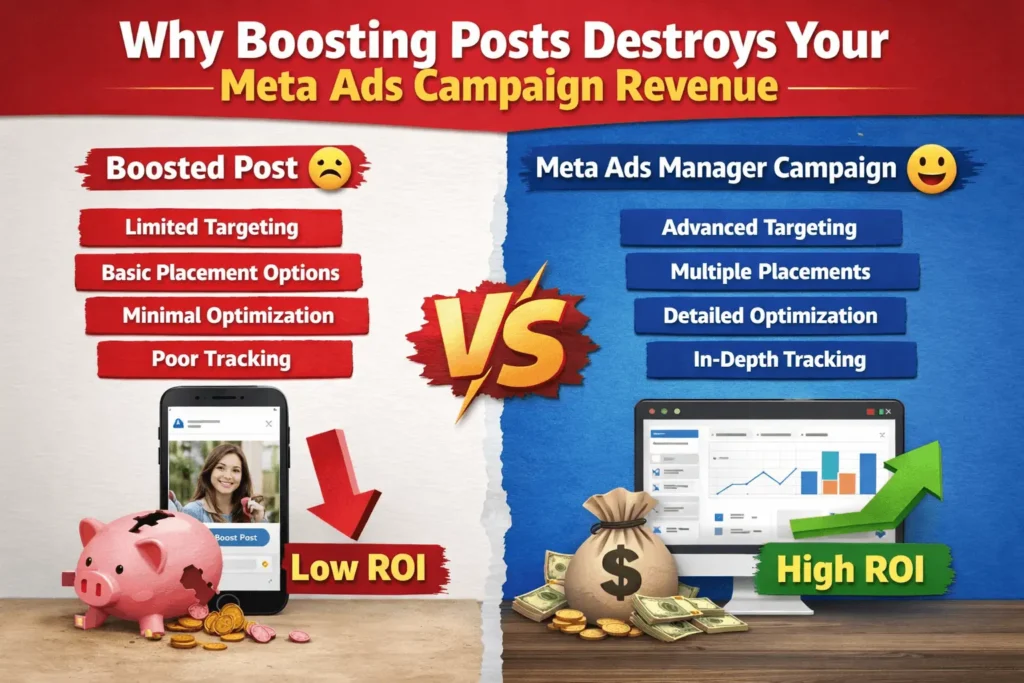
The “Boost Post” button is the most dangerous tool inside the Facebook and Instagram ecosystem. It was designed by Meta as a simplified, entry-level advertising feature to encourage small business owners to spend money without needing to understand complex advertising mechanics.
However, this simplicity comes at a massive cost. When you boost a post, Meta’s algorithm optimizes for vanity metrics. It finds users who are highly likely to “like,” “comment,” or “share” your content, but not necessarily people who are likely to fill out a lead capture form, book a consultation, or make a purchase.
These vanity metrics provide a false sense of progress. You might celebrate a viral video, but if that video resulted in zero closed deals, your system is failing. To generate actual Meta ads campaign revenue, you must abandon the boost button entirely and move into the Meta Ads Manager, where you can build campaigns specifically optimized for leads and sales.
What makes a Meta ads campaign revenue-driven?
A revenue-driven campaign is built on the foundation of tracking and intent. Unlike traditional marketing, which often relies on guesswork, a true acquisition system tracks every click, lead, and sale to calculate an exact Return on Investment (ROI).
When you build a tracking-first system rather than just running a random campaign, you eliminate the chaos of lost leads and wasted ad spend. You create a seamless, airtight flow from the moment a user sees your ad on Meta, down to the exact moment your sales team closes the deal over WhatsApp or an automated CRM pipeline.
This visibility allows you to kill losing campaigns instantly and pour your budget into the specific ad creatives and audiences that are actively generating pipeline. You will always know what we changed, why we changed it, and what it improved.
7 Steps to Build a Meta Ads Campaign Revenue System
If you want consistent enquiries and a system that actually closes, you must identify the biggest leak in your ads, website, or follow-up. Here are the seven proven steps NEULEAD uses to build high-performing systems for clinics, real estate firms, e-commerce brands, and B2B services.
1. Implement Proper Campaign Structures
A professional Meta ads campaign revenue system relies on a strict, organized structure within the Meta Ads Manager. The structure is divided into three levels: the Campaign level, the Ad Set level, and the Ad level.
At the Campaign level, you must select your core objective. You should almost exclusively choose “Leads” or “Sales.” By explicitly telling the algorithm your goal, Meta will deploy its machine learning to find users with a proven history of converting, rather than users who just casually browse.
At the Ad Set level, you define your targeting, budget, and placements. This is where you target specific demographics in Lagos or across Nigeria. Finally, the Ad level is where your creative (video or image) and your copywriting reside. A proper structure allows you to test multiple creatives against each other to see which one drives the lowest Cost Per Lead (CPL).
2. Install the Meta Pixel and Custom Events
You cannot scale what you do not track. A tracking-ready setup is the beating heart of any successful campaign. Before you spend a single Naira on ads, you must install the Meta Pixel on your website.
The Pixel is a piece of code that tracks user behavior. But simply having the Pixel is not enough; you must configure Custom Events. Custom Events tell Meta exactly when a meaningful action occurs, such as when a user submits a lead form or adds an item to their cart.
We verify tracking through Google Analytics 4 (GA4) and pixel events so your business decisions are based on hard data. When Meta knows exactly who is converting on your site, its algorithm becomes exponentially smarter, driving down your acquisition costs over time.
3. Build a “Money Page” that Converts
You can build the most brilliant ad campaign in the world, but if you drive that traffic to a slow, confusing website, you are actively burning your advertising budget. We don’t run ads without fixing the conversion path.
Your website must be a “money page” built for speed, clarity, and action. A proper capture system uses the right page structure: a bold Headline, immediate Proof (such as reviews or case studies), and an unavoidable Call to Action (CTA).
Furthermore, Google’s automated ranking systems look to reward content that provides a good page experience. Because the vast majority of your traffic will discover you on their phones, mobile-first optimization is completely non-negotiable. If your site takes more than three seconds to load, users will bounce, and Meta will penalize your ad account with higher costs.
4. Deploy Tracking-First Retargeting Strategies
Most visitors will not buy the first time they click your ad. They might get distracted, need to consult a partner, or want to do more research. If you do not have a retargeting strategy in place, those clicks are lost forever.
By implementing tracking-first setups using the Meta Pixel, we can deploy aggressive, highly targeted retargeting campaigns to recover warm visitors who clicked but didn’t instantly convert.
Retargeting is the secret weapon of a Meta ads campaign revenue system. Because these users are already familiar with your brand, retargeting ads carry a significantly lower Cost Per Click (CPC) and dramatically increase your overall conversion rate. This specific strategy is how we take high-traffic campaigns and turn them into high-conversion machines.
5. Automate Follow-Up with CRM and Chat Systems
Generating leads means nothing if your team drops the ball on the follow-up. Lead decay is a massive problem for Nigerian businesses. If you do not respond to a lead within five minutes, your chances of closing them drop significantly.
We build automation and CRM systems using Make/n8n and Google Sheets to route leads instantly. By deploying ManyChat and WhatsApp DM automation, we ensure human-like chat flows qualify buyers and escalate urgent cases to your team 24/7.
A true Meta ads campaign revenue setup never sleeps. It acts as a 24/7 digital salesperson that filters out unqualified traffic and only hands hot, ready-to-buy leads to your human representatives.
6. Avoid Search Engine-First Content
If you are running ads to a landing page, that page should also be optimized to rank organically on search engines. However, you must avoid creating search engine-first content made primarily to gain rankings.
If your landing page is stuffed with keywords and reads like it was written by a robot, human visitors will instantly bounce. Google explicitly warns against using extensive automation to produce content primarily for ranking manipulation.
Your content must be unique, valuable, and people-first. When you write naturally and clearly demonstrate firsthand expertise, users are far more likely to convert. This people-first approach satisfies both human buyers and search engine algorithms, providing a dual stream of traffic to your business.
7. Optimize for AI Search and LLM SEO
The digital landscape has permanently shifted. While paid ads provide immediate traffic, you must also future-proof your business by optimizing your landing pages for Large Language Models (LLMs) like ChatGPT, Perplexity, and Google’s AI Overviews.
LLM SEO is the practice of optimizing your web content so that AI models can effectively understand it, extract it, and present it to their users. When you build a landing page for your Meta ads campaign revenue system, it should simultaneously be structured for AI citations.
To rank in AI search engines, you must answer Natural Language Processing (NLP) questions directly. Find out what your customers are asking, use those exact questions as your subheadings, and answer them clearly. Additionally, you must implement Schema Markup (JSON-LD structured data) on your pages. Schema gives AI bots a direct roadmap to your content, making it highly likely that they will cite your brand as an authority.
Real Results: How NEULEAD Scales Revenue
We don’t “do marketing.” We build customer and operations systems—pages that convert, traffic that brings leads, SEO that compounds, and automation that runs the business. Here are actual, measurable results we’ve achieved for our clients in Lagos by implementing our tracking-first framework.
Admiralty Events: 87% Increase in Qualified Leads
Nnenna at Admiralty Events had a beautiful website, but they were struggling with low-quality inquiries. They were relying heavily on vanity metrics rather than a unified system.
By abandoning the boost button, tightening their ad targeting within the Ads Manager, and aggressively improving their landing page offer and lead capture questions, we increased their qualified leads by 87% in just 6 weeks. We improved their landing page conversion rate to 4.6% by creating a clearer offer, adding stronger trust blocks, and ensuring a faster page speed.
Dropping CPL from ₦6,800 to ₦1,200
Another client was suffering from a broken conversion path. They were running ads, but traffic wasn’t converting; people clicked and left. As a result, they were paying a devastating ₦6,800 per lead.
We stepped in and rebuilt their landing page for conversion. We verified their GA4 and pixel events, simplified their forms, and added an aggressive retargeting sequence to recover warm visitors. The result? Their Cost Per Lead (CPL) dropped to a highly profitable ₦1,200, drastically multiplying their Meta ads campaign revenue.
Stopping DM Lead Loss with Automation
A client was overwhelmed by Instagram DMs and WhatsApp messages, resulting in slow replies and missed after-hours leads.
We built a knowledge base and implemented ManyChat DM flows. We added automatic qualification, WhatsApp handoff, and Telegram escalation for their sales team. Lead capture increased by 41%, response times dropped under 2 minutes, and missed hot leads were reduced by 52% in just 3 weeks. Furthermore, the automated follow-up system we built saved their team 6 hours per week.
The Role of E-E-A-T in Landing Page Conversions
Google’s automated systems are designed to use many different factors to rank great content. They identify a mix of factors that can help determine which content demonstrates aspects of Experience, Expertise, Authoritativeness, and Trustworthiness, or what we call E-E-A-T.
While E-E-A-T is an organic ranking concept, it applies heavily to paid advertising conversions. Cold traffic clicking on your Meta ads arrives at your website with extreme skepticism. If your page lacks credibility, they will not convert.
Of these aspects, trust is the most important. You must ask “Who, How, and Why” about your content.
- Who: Make it explicitly clear who authored the content or owns the business using clear bylines or an “About Us” section.
- How: Explain how your product works or how your results were achieved, backed by real-world case studies and verifiable testimonials.
- Why: The primary purpose of your page must be to help people solve a problem, not just to extract their credit card information.
When your ad landing pages demonstrate strong E-E-A-T, you satisfy both the human buyer looking for a reliable solution and the search engine algorithms looking for high-quality content to rank and cite. (To learn more about these quality guidelines, review the official Google Search Central E-E-A-T Documentation– External Link).
Optimizing for Multimodal and Visual Search
As technology evolves, the way people search and interact with content is changing rapidly. People now perform multimodal searches where they snap a photo or upload an image, ask a question about it, and get a rich, comprehensive response.
To future-proof your Meta ads campaign revenue strategy, you must go beyond standard text. You must support your landing pages with high-quality, sharp images and videos. Always place these media assets near highly relevant text and use descriptive Alt Text so that both human visitors and AI algorithms can perfectly understand the visual context of your offer.
If you are running dynamic product ads or video ads on Meta, ensuring that the visual experience matches the landing page exactly creates a seamless transition that significantly reduces bounce rates.
Setting Up Bing Webmaster Tools for Ad Pages
One of the biggest secrets in modern digital acquisition is the importance of Microsoft Bing. Because Microsoft heavily backs OpenAI, Bing’s search index directly powers much of the AI-driven search capabilities within ChatGPT.
If your highly-converting ad landing pages are not indexed correctly on Bing, your chances of being cited organically by ChatGPT drop significantly. You must set up a free account on Bing Webmaster Tools (External Link), verify your domain, and submit your XML sitemaps. We have seen firsthand that a well-structured ad page indexed on Bing frequently translates directly into top citations on AI chat interfaces, providing free, high-intent traffic on top of your paid efforts.
Stop Marketing. Start Selling.
If you are tired of paying for impressions and likes while your sales pipeline remains empty, it is time to upgrade your infrastructure. You do not need more random boosted posts. You need a unified system that connects traffic, conversion, follow-up, and reporting.
At NEULEAD, we build the customer and operations systems that modern businesses need to thrive. We do not use templates, generic strategies, or fluff. We find the leak, build and launch the priority fix, and then optimize and scale what is working.
Are you ready to stop wasting your ad budget on vanity metrics? We don’t run ads without fixing the conversion path, and we don’t build websites that just look pretty; we build “money pages” that actually sell.
Request a Free Discovery Call Today and let NEULEAD transform your paid traffic into a predictable, scalable Meta ads campaign revenue system. Let’s grow your pipeline together.