
The most dangerous phase of a growing business is not the struggle to find customers; it is the chaotic period immediately following a successful marketing campaign. You might deploy brilliant paid ads, rank highly on search engines, and generate hundreds of inbound leads. However, if your business operations rely on manual data entry, scattered WhatsApp messages, and verbal approvals, that sudden influx of customers will completely break your infrastructure.
Many agencies focus entirely on top-of-funnel marketing. They celebrate vanity metrics like impressions and clicks, completely ignoring what happens after the sale is made. At NEULEAD, a Revenue + Systems agency headquartered in Lekki Phase 1, Lagos, we know that generating revenue is only half the battle.
If your marketing strategy stops at getting attention, you are actively burning your budget. To build a business that scales predictably, you must move beyond marketing and implement pure business operations systems.
In this comprehensive 2026 guide, we will break down the exact framework for operations automation. We will teach you how to track orders, streamline internal approvals, and build a unified backend that allows your team to handle ten times the volume without descending into operational chaos.
What is Operations Automation?
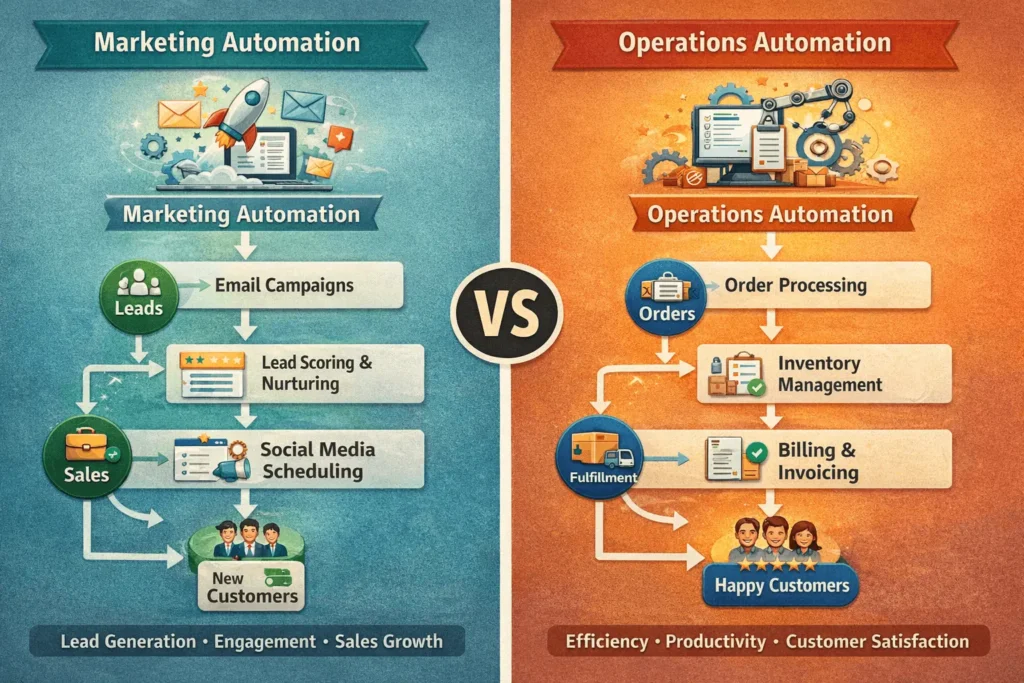
To scale efficiently, you must first understand the distinction between marketing automation and operations automation.
Marketing and CRM automation focus on the front end of your business. These systems capture leads, send follow-up emails, and route inquiries to your sales team to help close the deal. They are designed to manage the customer journey up to the point of purchase.
Operations automation takes over the exact second the invoice is paid. It is the invisible, highly technical backend architecture that fulfills the promise your marketing team made. It involves automating inventory updates, routing manufacturing orders, triggering internal compliance approvals, and updating delivery dashboards in real-time.
When a real estate developer closes a client, operations automation handles the legal document generation and payment tracking. When an e-commerce brand sells a product, it instantly notifies the warehouse, generates a shipping label, and texts the customer a tracking link. By automating these repetitive, manual tasks, you eliminate human error and dramatically increase your profit margins.
The Hidden Cost of Manual Internal Approvals
The biggest bottleneck in any scaling professional service firm or product business is the internal approval process.
Consider a standard scenario: A sales representative closes a massive enterprise deal. Before the work can begin, the finance director must approve the payment terms, the legal team must approve the contract, and the project manager must allocate resources.
If your business manages this through manual email chains, you are losing money. Emails get buried. Directors go on vacation without delegating authority. Sales reps are forced to constantly “follow up” with their own internal team just to get permission to do their jobs.
This manual friction leads to delayed project kickoffs, frustrated customers, and a massive waste of high-value employee time. By implementing strict operations automation, you digitize the approval matrix. You ensure that requests are instantly routed to the correct decision-maker via direct messaging apps, allowing them to approve or deny a request with a single click.
7 Ways to Build Operations Automation Without Chaos
If you want your business to run like a predictable machine, you must identify the biggest leak in your operational chain. Here are the seven proven technical steps NEULEAD uses to build high-performing operations systems for businesses globally.
1. Centralize Your Operations Database (Airtable)
Automation simply scales chaos if your data is fragmented. Before building complex workflows, you must establish a single source of truth for your business operations.
We highly recommend moving away from scattered Excel files and adopting a relational database like Airtable or a highly structured Google Sheet. Your operations database should track every single active order, project, or client.
You must create distinct, unchangeable columns for data points like “Order ID,” “Payment Status,” “Fulfillment Stage,” and “Assigned Manager.” By centralizing this data, your automation tools have a clean, structured repository to read from and write to, ensuring absolute accuracy across your entire company.
2. Automate Payment and Order Ingestion
The trigger for your operations automation sequence is usually a successful payment or a signed contract. You must completely eliminate the process of a human manually typing a new order into your database.
Using visual automation tools like Make (formerly Integromat) or n8n, you can listen for webhooks from your payment gateways. Whether you use Stripe, Paystack, Flutterwave, or PayPal, the moment a customer’s credit card is successfully charged, the gateway sends a JSON payload to your automation platform.
Make instantly parses this data, extracts the customer’s information, and creates a new, perfectly formatted row in your Airtable database. This ensures that fulfillment can begin literally seconds after the payment clears, with zero manual data entry.
3. Build 1-Click Internal Approval Workflows
Once the order is ingested, it often requires human verification before fulfillment begins. To solve the email bottleneck, we build 1-click approval workflows using Make and Telegram (or Slack).
When a high-value order lands in your database, your automation tool queries the system to see who the assigned director is. It then sends an instant, formatted Telegram message to that specific director.
The message includes all the context: “🚨 APPROVAL REQUIRED: New $50,000 order from Client X. Payment verified.” Below the text, the automation generates two clickable webhook buttons right inside the chat interface: [APPROVE] and [REJECT].
When the director taps “Approve” on their phone, the webhook fires back to Make, automatically updates the Airtable status to “Approved,” and triggers the next phase of fulfillment. This reduces approval times from days to seconds.
4. Trigger Automated Client Onboarding
The period immediately after a customer pays is when they are most susceptible to buyer’s remorse. Operations automation ensures they feel immediately taken care of, without your team lifting a finger.
The moment the internal approval clears, your system should automatically trigger the onboarding sequence. Using Make, you can instantly generate a customized PDF contract or welcome packet using a tool like Google Docs or DocuSign.
Simultaneously, the system connects to the WhatsApp Business API or an email provider to send the client their onboarding materials, login credentials, and next steps. This creates a flawless, highly professional customer experience that operates 24/7.
5. Automate Task Delegation and Resource Allocation
Fulfilling an order requires assigning work to your staff. If managers are manually creating tasks in project management software, you are wasting operational bandwidth.
Your operations automation pipeline can seamlessly connect your central Airtable database to your team’s project management tools, such as Asana, Trello, or ClickUp.
When an order reaches the “Fulfillment” stage, the automation creates a standardized checklist of tasks, assigns specific due dates based on the project kickoff, and assigns them to the relevant team members. It completely removes the administrative burden from your project managers, allowing them to focus on quality control rather than data entry.
6. Set Up Automated Inventory and Milestone Alerts
In product-based businesses, running out of stock destroys revenue. In service-based businesses, missing a project milestone destroys trust. Automation solves both.
You can configure scheduled scenarios in Make or n8n that run every hour to check your Airtable database. If the automation detects that a specific SKU’s inventory level has fallen below the minimum threshold, it instantly pings the procurement team on Slack to reorder.
Similarly, if a client project has been stuck in the “Design Phase” for more than five days without an update, the system automatically escalates a warning to the department head. This proactive alerting ensures that operational bottlenecks are resolved before the customer ever notices a delay.
7. Build Real-Time Dashboards for Leadership
The ultimate goal of operations automation is to give business owners absolute visibility without requiring them to micromanage.
Because every single action—from payment capture to final delivery—is automatically logged and timestamped in your central database, building real-time dashboards becomes effortless. You can connect tools like Google Looker Studio directly to your Airtable or Google Sheets.
Leadership can open a dashboard on their phone and instantly see how many orders are pending approval, the average fulfillment time per employee, and the exact bottleneck in the operational pipeline. This tracking-first approach ensures that all business decisions are based on hard, verifiable data.
The NEULEAD Customer Engine™
Building isolated automations will not fix a fundamentally broken business. Most brands do not need a few random “zap” integrations; they need a cohesive system that handles the customer lifecycle from the first click to the final delivery.
At NEULEAD, we categorize our services into a proprietary four-step framework known as the Customer Engine™. Operations automation falls into the critical final cluster, ensuring the promises made by marketing are actually fulfilled.
1. Capture (Conversion Websites)
We build high-converting WordPress websites and landing pages focused entirely on speed, clarity, and action. Your digital presence must be a “money page.” We ensure mobile-first optimization so that traffic seamlessly converts into trackable leads and direct sales.
2. Attract (Paid Ads & SEO)
Once the capture mechanism is flawless, we turn on the traffic. We manage Paid Ads across Meta, Google, X, and TikTok, alongside rigorous Local and LLM SEO Services. We ensure your brand ranks for buyer-intent searches locally and internationally.
3. Convert (Tracking-First Retargeting)
We do not rely on guesswork or vanity metrics. We verify tracking through Google Analytics 4 (GA4) and pixel events so your business decisions are based on data. By deploying aggressive retargeting strategies, we recover warm visitors who clicked your links but did not instantly convert.
4. Multiply (Automation & Operations)
This is where we build the backend machine. We build operational pipelines and team alerts using Make/n8n so orders never slip through. By automating order tracking, internal approvals, and task assignment, we multiply the efficiency of your staff, allowing you to scale revenue without linearly scaling your headcount.
Real Results: How Operations Systems Drive Profit
We do not optimize vibes; we optimize revenue. We believe that if an activity does not directly move the needle, it is just noise. Here are actual, measurable results we’ve achieved for our clients by abandoning manual chaos and implementing the NEULEAD framework globally.
Saving 6 Hours Per Week with Automated Routing
An international client of ours was completely overwhelmed by scattered lead sources and chaotic manual order entry. Their operations team was missing crucial handoffs due to massive time zone differences and disorganized spreadsheets.
We stepped in and built a comprehensive operations automation pipeline. We integrated their data sources directly into a central database and added Telegram escalation protocols for their directors. This system eliminated manual data entry, saving their operations team over 6 hours per week. Furthermore, it dropped global response times to under 2 minutes and reduced missed hot leads by a staggering 52% in just 3 weeks.
Admiralty Events: 87% Increase in Qualified Leads
Nnenna at Admiralty Events had a beautiful website, but they were struggling with low-quality inquiries and chaotic internal tracking. By tightening their marketing targeting and aggressively improving their landing page offer, we integrated our tracking-first systems.
The result was an 87% increase in qualified leads in just 6 weeks. We improved their landing page conversion rate to 4.6% by creating a clearer offer, stronger trust blocks, ensuring a faster page speed, and simplifying the intake form. Because the backend operations were automated, their team could handle the massive influx of new business without breaking a sweat.
Dropping CPL from ₦6,800 to ₦1,200
Another client was suffering from a broken conversion path. They were driving traffic, but the manual handoff between marketing and operations was destroying the customer experience, resulting in a devastating Cost Per Lead (CPL) of ₦6,800.
We rebuilt their landing page for conversion, verified their GA4 events, and implemented a robust pipeline to route data instantly. Following these structural and tracking fixes, their CPL dropped to a highly profitable ₦1,200, drastically increasing their profit margins and operational efficiency.
Avoid Natural Language Processing (NLP) Bottlenecks
While the technical setup of your backend operations is critical, you must also ensure your front-end content is optimized for the modern web. Search engines and AI models rely heavily on Natural Language Processing (NLP) to understand what your business does.
When you write naturally and clearly demonstrate your operational expertise on your website, users are far more likely to trust you. You must explicitly state who you are, how your fulfillment process works, and why your automated systems benefit the end consumer. A flawless internal approval workflow cannot save your business if your public-facing website fails to clearly communicate your value proposition in a language both humans and algorithms understand.
Stop Marketing. Start Selling.
If you are tired of paying for impressions, likes, and vanity marketing while your backend operations collapse under the weight of manual tracking, it is time to upgrade your infrastructure. You do not need another generic marketing campaign. You need a unified system that connects traffic, conversion, follow-up, and pure business operations.
At NEULEAD, we build the customer and operations systems that modern businesses need to thrive globally. We do not use templates, generic strategies, or fluff. We find the leak, build and launch the priority fix, and then optimize and scale what is working. If you sell something real, we can build the system.
Are you ready to stop losing sleep over manual order tracking and delayed internal approvals? We don’t generate demand without building the operational systems required to fulfill it.
Request a Free Discovery Call Today and let NEULEAD transform your manual chaos into a predictable, scalable revenue machine powered by elite operations automation. Let’s multiply your pipeline together.